
 Facebook
 Google
 GitHub
 Linkedin
Analog Integrated Circuits
Linear Computational Circuitry
35 questions By Tony R. Kuphaldt
-
Question 7 of 35
We know that an opamp connected to a voltage divider with a voltage division ratio of \(\frac{1}{2}\) will have an overall voltage gain of 2, and that the same circuit with a voltage division ratio of \(\frac{2}{3}\) will have an overall voltage gain of 1.5, or \(\frac{3}{2}\):

There is definitely a mathematical pattern at work in these non-inverting opamp circuits: the overall voltage gain of the circuit is the mathematical inverse of the feedback network’s voltage gain.
Building on this concept, what do you think would be the overall function of the following opamp circuits?
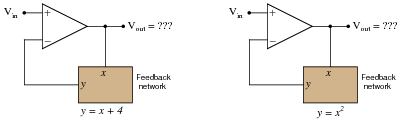
Reveal answerFor the left−hand circuit: Vout = Vin − 4 For the right−hand circuit: Vout = √ VinThe result of placing a mathematical function in the feedback loop of a non-inverting opamp circuit is that the output becomes the inverse function of the input: it literally becomes the value of x needed to solve for the input value of y:
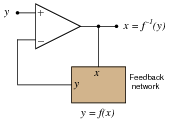
Notes:What is shown in this question and answer is a stark example of the power of negative feedback in a mathematical system. Here, we see the opamp’s ability to solve for the input variable in an equation which we know the output value of. To state this in simpler terms, the opamp “does algebra” for us by “manipulating” the feedback network’s equation to solve for x given an input signal of y.
-
Question 8 of 35
The simple resistor network shown here is known as a passive averager. Describe what the word “passive” means in this context, and write an equation describing the output voltage (Vd) in terms of the input voltages (Va, Vb, and Vc):

Hint: there is a network theorem that directly applies to this form of circuit, and it is known as Millman’s Theorem. Research this theorem and use it to generate your equation!
Reveal answer“Passive” means that the circuit contains no amplifying components.
Vd = Va Vb Vc 3Notes:Students need to realize that even passive circuits are able to model (some) mathematical functions! Ask your students if they can think of any network analysis methods to easily calculate the output voltage (Vd) of this circuit, given the input voltages. There is one theorem in particular that works very well for this particular circuit.
-
Question 9 of 35
Add an op-amp circuit to the output of this passive averager network to produce a summer circuit: an operational circuit generating an output voltage equal to the sum of the four input voltages. Then, write an equation describing the whole circuit’s function.

Reveal answer
Vsum = Va Vb Vc Vd Notes:The equation for this circuit is simple enough as to require no explanation. How your students derived this equation, from the base equation of a passive averager network, on the other hand, is worth discussion. Discuss with them the necessary gain of the op-amp circuit, and how this gain figure converts an averaging function into a summing function.






very good worksheets