
 Facebook
 Google
 GitHub
 Linkedin
Analog Integrated Circuits
Linear Computational Circuitry
35 questions By Tony R. Kuphaldt
-
Question 10 of 35
Write a mathematical equation for this op-amp circuit, assuming all resistor values are equal:

What is this circuit typically called?
Reveal answerc = −(a b)
This type of circuit is typically called an inverting summer.
Follow-up question: explain why the addition of another resistor in this circuit is recommended for optimum accuracy, as shown in the following schematic.

Challenge question: write an equation describing the proper value of this extra resistor.
Notes:Ask your students about the proper resistor values for an inverting summer circuit. The choices of resistor values are definitely not the same for inverting summer and non-inverting summer circuits alike! Discuss why the values are what they are in an inverting summer circuit (using Ohm’s Law to analyze the circuit’s function), emphasizing comprehension over rote memorization.
-
Question 11 of 35
This opamp circuit is known as a difference amplifier, sometimes called a subtractor. Assuming that all resistor values are equal in the circuit, write an equation expressing the output (y) as a function of the two input voltages (a and b):
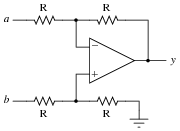
Reveal answery = b − a
Notes:Work through some example conditions of input voltages and resistor values to calculate the output voltage using Ohm’s Law and the general principle of negative feedback in an opamp circuit (namely, an assumption of zero voltage differential at the opamp inputs). The goal here is to have students comprehend why this circuit subtracts one voltage from another, rather than just encourage rote memorization.
-
Question 12 of 35
Re-write the equation for this differential amplifier circuit, assuming that the marked resistor fails open:
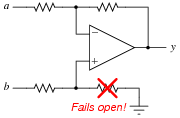
Reveal answery = 2b − a
Notes:Ask your students to explain how they would verify the failure of the marked resistor, using a voltmeter (not an ohmmeter!).





very good worksheets