
 Facebook
 Google
 GitHub
 Linkedin
Analog Integrated Circuits
Linear Computational Circuitry
35 questions By Tony R. Kuphaldt
-
Question 13 of 35
Write a mathematical expression in the form of y = ... x describing the function of this circuit:
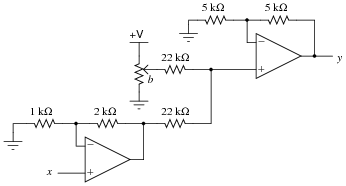
Reveal answery = 3x b
Notes:In this circuit, we combine two different op-amp functions into one system, embodying a linear equation. Discuss with your students what circuit alterations would be required to change the coefficients of this equation.
If it helps some of your students understand the overall function of this circuit better, you might want to ask other students to outline which groups of components in this circuit perform which portion of the equation (while the circuit schematic is displayed on the whiteboard for all to see).
-
Question 14 of 35
How much current will go through the load in this op-amp circuit?

What impact will a change in load resistance have on the operation of this circuit? What will change, if anything, supposing the load resistance were to increase?
Reveal answerIload = 1.818 mA
If the load changes resistance, there will be no effect on the amount of current through it, although there will be an effect on the output voltage of the opamp!
Notes:The purpose of this question, besides giving students reason to review a constant-current opamp circuit, is to preview the behavior of an active integrator using the same resistor and input voltage values (question #01008).
-
Question 15 of 35
∫f(x) dx Calculus alert!
How much current will go “through” the capacitor in this op-amp circuit, and what effect does this have on the output voltage?
Reveal answerIC = 1.818 mA
This circuit is an integrator: its output voltage changes over time at a rate proportional to the input voltage magnitude.
Follow-up question: what is the output voltage rate-of-change over time \(\frac{dv}{dt}\) for the circuit shown in the question?
Notes:This question is a good review of capacitor theory (relating voltage and current with regard to a capacitor), as well as an introduction to how op-amp circuits can perform calculus functions.
Challenge your students to calculate the output [dv/dt] without using a calculator!





very good worksheets