
 Facebook
 Google
 GitHub
 Linkedin
Analog Integrated Circuits
Linear Computational Circuitry
35 questions By Tony R. Kuphaldt
-
Question 25 of 35
How much current (I) would have to be forced through the resistor in order to generate an output voltage of 5 volts?

Reveal answerI = 2.273 mA
Notes:The purpose of this question, besides giving students reason to review a current-to-voltage converter opamp circuit, is to preview the behavior of an active differentiator using the same resistor and output voltage values (question #02698).
-
Question 26 of 35
∫f(x) dx Calculus alert!
How much current (I) would have to be forced through the resistor in order to generate an output voltage of 5 volts?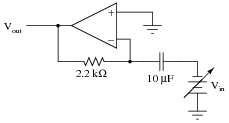
At what rate would Vin have to increase in order to cause this amount of current to go “through” the capacitor, and thereby cause 5 volts to appear at the Vout terminal? What does this tell us about the behavior of this circuit?
Reveal answerI = 2.273 mA
\(\frac{dVin}{dt}\) = 227.3 volts/second
The fact that this circuit outputs a voltage proportional to the rate of change over time of the input voltage indicates that it is a differentiator.
Notes:This question is a good review of capacitor theory (relating voltage and current with regard to a capacitor), as well as an introduction to how op-amp circuits can perform calculus functions.
-
Question 27 of 35
∫f(x) dx Calculus alert!
We know that the output of a differentiator circuit is proportional to the time-derivative of the input voltage:
Vout ∝ dVin dtBut how do we turn this proportionality into an exact equality, so that it accounts for the values of R and C? Although the answer to this question is easy enough to simply look up in an electronics reference book, it would be great to actually derive the exact equation from your knowledge of electronic component behaviors! Here are a couple of hints:
I = V Ri = C dv dtReveal answerVout = − RC ( dVin dt) Follow-up question: why is there a negative sign in the equation?
Notes:The two “hint” equations given at the end of the question beg for algebraic substitution, but students must be careful which variable(s) to substitute! Both equations contain an I, and both equations also contain a V. The answer to that question can only be found by looking at the schematic diagram: do the resistor and capacitor share the same current, the same voltage, or both?






very good worksheets