
 Facebook
 Google
 GitHub
 Linkedin
Analog Integrated Circuits
Linear Computational Circuitry
35 questions By Tony R. Kuphaldt
-
Question 4 of 35
Write a mathematical expression in the form of y = ... x describing the function of this circuit:

Reveal answery = 2x
Notes:Your students should be able to recognize that this amplifier circuit has a voltage gain of 2, but expressing it in the form of an equation using variables such as x and y may be something very new to them. Discuss with your students the significance of this notation: that a circuit may embody an equation. Analog computers may be “obsolete” technology, but they still have many practical applications.
-
Question 5 of 35
Write a mathematical expression in the form of y = ... x describing the function of this circuit:
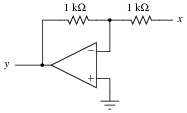
Reveal answery = −x
Notes:Your students should be able to recognize that this amplifier circuit has a voltage gain of 1, and that it is inverting in nature, but expressing it in the form of an equation using variables such as x and y may be something very new to them. Discuss with your students the significance of this notation: that a circuit may embody an equation.
-
Question 6 of 35
Ideally, an inverting amplifier circuit may be comprised of just one op-amp and two resistors, as such:

However, if high accuracy is desired, a third resistor must be added to the circuit, in series with the other op-amp input:
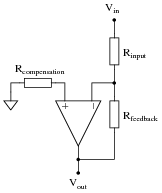
Explain what this “compensation” resistor is compensating for, and also what its value should be.
Reveal answerThe compensation resistor compensates for errors introduced into the voltage divider network due to input bias current. Its value should be equal to the parallel equivalent of Rinput and Rfeedback.
Notes:First, your students will have to know what “bias currents” are in op-amp circuits, so begin your discussion of this question with a call for this definition. Why the compensation resistor value must be equal to the parallel equivalent of the two resistors in the voltage divider is something that confuses most students. The key to understanding it is network analysis, in particular Thévenin’s and Norton’s theorems.





very good worksheets