
 Facebook
 Google
 GitHub
 Linkedin
Analog Integrated Circuits
Linear Computational Circuitry
35 questions By Tony R. Kuphaldt
-
Question 16 of 35
What will the output voltage of this integrator circuit do when the DPDT (“Double-Pole, Double-Throw”) switch is flipped back and forth?

Be as specific as you can in your answer, explaining what happens in the switch’s “up” position as well as in its “down” position.
Reveal answerWith the switch in the “up” position, the opamp output linearly ramps in a negative-going direction over time. With the switch in the “down” position, the opamp output linearly ramps in a positive-going direction over time.
Follow-up question: what do you suppose the output of the following circuit would do over time (assuming the square wave input was true AC, positive and negative)?

Notes:The DPDT switch arrangement may be a bit confusing, but its only purpose is to provide a reversible input voltage polarity. Discuss with your students the directions of all currents in this circuit for both switch positions, and how the opamp output integrates over time for different input voltages.
-
Question 17 of 35
Calculate the output voltage rate-of-change ([dv/dt]) for this active integrator circuit, being sure to explain all the steps involved in determining the answer:

Reveal answer\(\frac{dv}{dt}\)= 74.47 volts/second
Notes:Ask your students to relate the capacitive “Ohm’s Law” equation to their solutions:
i = C dv dt -
Question 18 of 35
Calculate the input voltage needed to produce an output voltage rate-of-change \(\frac{dv}{dt}\) of -25 volts per second in this active integrator circuit:
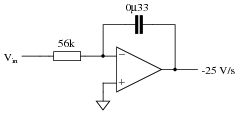
Reveal answerVin = 462 mV
Notes:Ask your students to relate the capacitive “Ohm’s Law” equation to their solutions:
i = C dv dt






very good worksheets