
 Facebook
 Google
 GitHub
 Linkedin
Discrete Semiconductor Devices and Circuits
Oscillator Circuits
49 questions By Tony R. Kuphaldt
-
Question 37 of 49
Identify the type of oscillator circuit shown in this schematic diagram:

Also, write the equation describing the operating frequency of this type of oscillator circuit.
Reveal answerThis is a Clapp oscillator circuit, and the tank circuit establishes its frequency of operation.
$$f = \frac{1}{2{\pi}\sqrt{L_1 (\frac{1}{\frac{1}{C_1}+\frac{1}{C_2}+\frac{1}{C_3}})}}$$
Follow-up question: you may notice that the Clapp oscillator is just a variation of the Colpitts oscillator design. If C3 is much smaller than either C1 or C2, the frequency stability of the oscillator circuit will be relatively unchanged by variations in parasitic capacitance throughout the circuit (especially transistor junction “Miller effect” capacitances). Explain why, and how the following equation provides an approximation of operating frequency under these conditions:
$$f \approx \frac{1}{2\pi \sqrt{L_1C_3}}$$
Notes:Ask your students to describe the amount of phase shift the tank circuit provides to the feedback signal. Also, ask them to explain how the oscillator circuit’s natural frequency may be altered.
The only “trick” to figuring out the answer here is successfully identifying which capacitors are part of the tank circuit and which are not. Remind your students if necessary that tank circuits require direct (galvanic) connections between inductance and capacitance to oscillate - components isolated by an amplifier stage or a significant resistance cannot be part of a proper tank circuit. The identity of the constituent components may be determined by tracing the path of oscillating current between inductance(s) and capacitance(s).
-
Question 38 of 49
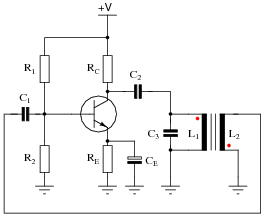
Identify the type of oscillator circuit shown in this schematic diagram, and draw the transformer phasing dots in the right places to ensure regenerative feedback:

Also, write the equation describing the operating frequency of this type of oscillator circuit.
Reveal answerThis is an Armstrong oscillator circuit, and the combination of capacitor C3 and primary transformer winding inductance L1 establishes its frequency of operation.
$$f = \frac{1}{2\pi \sqrt{L_1C_3}}$$
 Notes:
Ask your students to describe the amount of phase shift the transformer-based tank circuit provides to the feedback signal. Having them place phasing dots near the transformer windings is a great review of this topic, and a practical context for winding “polarity”. Also, ask them to explain how the oscillator circuit’s natural frequency may be altered.
-
Question 39 of 49
Modify the schematic diagram for a Hartley oscillator to include a crystal. What advantage(s) does a crystal-controlled Hartley oscillator exhibit over a regular Hartley oscillator?
Reveal answer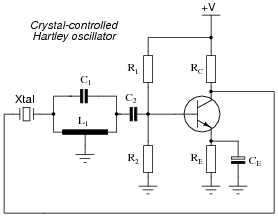
Follow-up question: does the resonant frequency of the tank circuit have to match the crystal’s resonant frequency? Why or why not?
Notes:Ask your students to explain what purpose a crystal serves in an oscillator circuit that already contains a tank circuit for tuning.


