Facebook
 Google
 GitHub
 Linkedin
Discrete Semiconductor Devices and Circuits
Oscillator Circuits
49 questions By Tony R. Kuphaldt
-
Question 40 of 49
How does the quality factor (Q) of a typical quartz crystal compare to that of a regular LC tank circuit, and what does this indicate about the frequency stability of crystal-controlled oscillators?
Reveal answerQ values of several thousand are commonplace with crystals, while Q values in excess of 10 are considered good for LC tank circuits!
Notes:Note that I did not answer the frequency stability question, but left that for the students to figure out.
-
Question 41 of 49
Under certain conditions (especially with certain types of loads) it is possible for a simple one-transistor voltage amplifier circuit to oscillate:
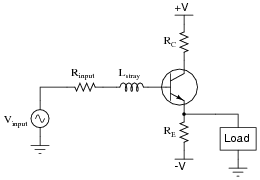
Explain how this is possible. What parasitic effects could possibly turn an amplifier into an oscillator?
Reveal answerHere is a re-drawn representation of the amplifier circuit, with the base-emitter capacitance shown:
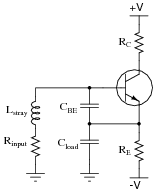
Follow-up question: what type of oscillator circuit does this resemble?
Challenge question: what type(s) of load would tend to make this circuit oscillate more readily than others?
Notes:This question reinforces a very important lesson in electronic circuit design: parasitic effects may produce some very unexpected consequences! Just because you didn’t intend for your amplifier circuit to oscillate does not mean than it won’t.
-
Question 42 of 49
Calculate the operating frequency of this oscillator circuit:

Explain why the operating frequency will not be the same if the transistor receives its feedback signal from the other side of the bridge, like this:
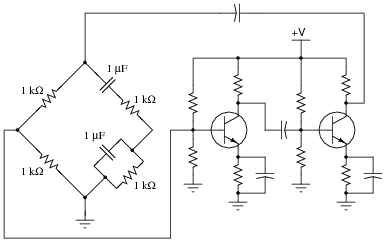
Reveal answerf = 159.155 Hz
If the feedback signal comes from the other side of the bridge, the feedback signal’s phase shift will be determined by a different set of components (primarily, the coupling capacitors and bias network resistances) rather than the reactive arms of the bridge.
Notes:Given the phase shift requirements of a two-stage oscillator circuit such as this, some students may wonder why the circuit won’t act the same in the second configuration. If such confusion exists, clarify the concept with a question: “What is the phase relationship between input and output voltages for the bridge in these two configurations, over a wide range of frequencies?” From this observation, your students should be able to tell that only one of these configurations will be stable at 159.155 Hz.