Facebook
 Google
 GitHub
 Linkedin
Discrete Semiconductor Devices and Circuits
Oscillator Circuits
49 questions By Tony R. Kuphaldt
-
Question 43 of 49
This circuit generates quasi-sine waves at its output. It does so by first generating square waves, integrating those square waves (twice) with respect to time, then amplifying the double-integrated signal:

Identify the sections of this circuit performing the following functions:
- Square wave oscillator:
- First integrator stage:
- Second integrator stage:
- Buffer stage (current amplification):
- Final gain stage (voltage amplification):
Reveal answer- Square wave oscillator: R1 through R4, C1 and C2, Q1 and Q2
- First integrator stage: R5 and C3
- Second integrator stage: R6 and C4
- Buffer stage (current amplification): Q3 and R7
- Final gain stage (voltage amplification): R8 and R9, Rpot, Q4, and C7
Notes:The purpose of this question is to have students identify familiar sub-circuits within a larger, practical circuit. This is a very important skill for troubleshooting, as it allows technicians to divide a malfunctioning system into easier-to-understand sections.
-
Question 44 of 49
Calculate the operating frequency of the following oscillator circuit, if C1 = 0.033 μF and L1 = 175 mH:
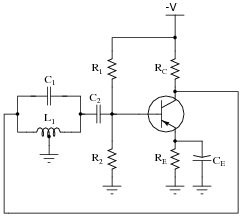
Reveal answerf = 2.094 kHz
Notes:Note to your students that the following formula (used to obtain the answer shown) is valid only if the tank circuit’s Q factor is high (at least 10 is the rule-of-thumb):
$$f = \frac{1}{2\pi \sqrt{LC}}$$
-
Question 45 of 49
Calculate the operating frequency of the following oscillator circuit, if C1 = 0.047 μF and L1 = 150 mH:

Reveal answerf = 1.896 kHz
Notes:Note to your students that the following formula (used to obtain the answer shown) is valid only if the tank circuit’s Q factor is high (at least 10 is the rule-of-thumb):
$$f = \frac{1}{2\pi \sqrt{LC}}$$