Facebook
 Google
 GitHub
 Linkedin
Discrete Semiconductor Devices and Circuits
Oscillator Circuits
49 questions By Tony R. Kuphaldt
-
Question 22 of 49
A clever way to produce sine waves is to pass the output of a square-wave oscillator through a low-pass filter circuit:
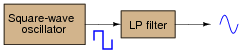
Explain how this principle works, based on your knowledge of Fourier’s theorem.
Reveal answerThe LP filter blocks all harmonics of the square wave except the fundamental (1st harmonic), resulting in a sinusoidal output.
Notes:Ask your students what they think about the rolloff requirement for this LP filter. Will any LP filter work, or do we need something special?
-
Question 23 of 49
Predict how the operation of this relaxation oscillator circuit will be affected as a result of the following faults. Consider each fault independently (i.e. one at a time, no multiple faults):

- Capacitor C1 fails open:
- Capacitor C1 fails shorted:
- Resistor R1 fails open:
- Solder bridge (short) past resistor R1:
For each of these conditions, explain why the resulting effects will occur.
Reveal answer- Capacitor C1 fails open: Constant (unblinking) light from the neon bulb.
- Capacitor C1 fails shorted: No light from the bulb at all.
- Resistor R1 fails open: No light from the bulb at all.
- Solder bridge (short) past resistor R1: Very bright, constant (unblinking) light from the bulb, possible bulb failure resulting from excessive current.
Notes:The purpose of this question is to approach the domain of circuit troubleshooting from a perspective of knowing what the fault is, rather than only knowing what the symptoms are. Although this is not necessarily a realistic perspective, it helps students build the foundational knowledge necessary to diagnose a faulted circuit from empirical data. Questions such as this should be followed (eventually) by other questions asking students to identify likely faults based on measurements.
-
Question 24 of 49
Predict how the operation of this strobe light circuit will be affected as a result of the following faults. Consider each fault independently (i.e. one at a time, no multiple faults):

- Capacitor C1 fails open:
- Capacitor C1 fails shorted:
- Resistor R2 fails open:
- Solder bridge (short) past resistor R2:
- Resistor R4 fails open:
- Transistor Q4 fails open (collector-to-emitter):
- Capacitor C2 fails open:
- Capacitor C2 fails shorted:
For each of these conditions, explain why the resulting effects will occur.
Reveal answer- Capacitor C1 fails open: No light from flash tube, possible failure of transformer primary winding and/or transistor Q4 due to overheating.
- Capacitor C1 fails shorted: No light from flash tube.
- Resistor R2 fails open: No light from flash tube.
- Solder bridge (short) past resistor R2: Faster strobe rate for any given position of potentiometer R1, possibility of adjusting the strobe rate too high where the flash tube just refuses to flash.
- Resistor R4 fails open: No light from flash tube.
- Transistor Q4 fails open (collector-to-emitter): No light from flash tube.
- Capacitor C2 fails open: Possible damage to transistor Q4 from excessive transient voltages.
- Capacitor C2 fails shorted: No light from flash tube, Q4 will almost certainly fail due to overheating.
Notes:The purpose of this question is to approach the domain of circuit troubleshooting from a perspective of knowing what the fault is, rather than only knowing what the symptoms are. Although this is not necessarily a realistic perspective, it helps students build the foundational knowledge necessary to diagnose a faulted circuit from empirical data. Questions such as this should be followed (eventually) by other questions asking students to identify likely faults based on measurements.