
 Facebook
 Google
 GitHub
 Linkedin
AC Electric Circuits
Peak, Average, and RMS Measurements
10 questions By Tony R. Kuphaldt
-
Question 4 of 10
Determine the RMS amplitude of this sinusoidal waveform, as displayed by an oscilloscope with a vertical sensitivity of 0.2 volts per division:
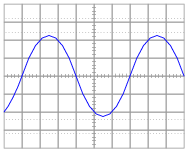
Reveal answerThe RMS amplitude of this waveform is approximately 0.32 volts.
Notes:Students must properly interpret the oscilloscope’s display, then correctly convert to RMS units, in order to obtain the correct answer for this question.
-
Question 5 of 10
Determine the RMS amplitude of this square-wave signal, as displayed by an oscilloscope with a vertical sensitivity of 0.5 volts per division:
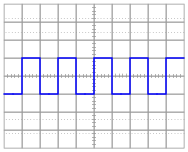
Reveal answerThe RMS amplitude of this waveform is 0.5 volt.
Notes:Many electronics students I’ve talked to seem to think that the RMS value of a waveform is always [(√2)/2], no matter what the waveshape. Not true, as evidenced by the answer for this question!
Students must properly interpret the oscilloscope’s display in order to obtain the correct answer for this question. The “conversion” to RMS units is really non-existent, but I want students to be able to explain why it is and not just memorize this fact.
-
Question 6 of 10
Suppose two voltmeters are connected to source of “mains” AC power in a residence, one meter is analog (D’Arsonval PMMC meter movement) while the other is true-RMS digital. They both register 117 volts while connected to this AC source.
Suddenly, a large electrical load is turned on somewhere in the system. This load both reduces the mains voltage and slightly distorts the shape of the waveform. The overall effect of this is average AC voltage has decreased by 4.5% from where it was, while RMS AC voltage has decreased by 6% from where it was. How much voltage does each voltmeter register now?
Reveal answerAnalog voltmeter now registers: 111.7 volts
True-RMS digital voltmeter now registers: 110 volts
Notes:Students sometimes have difficulty grasping the significance of PMMC meter movements being “average-responding” rather than RMS-responding. Hopefully, the answer to this question will help illuminate this subject more.




Hello, sorry but i doubt the asnwer to question #5, or at least i would ask for a better explanation.
For what i know, RMS amplitude of such a waveform is 1 x sqrt(0,5), while 0,5 seems to be average amplitude.