
 Facebook
 Google
 GitHub
 Linkedin
AC Electric Circuits
Peak, Average, and RMS Measurements
10 questions By Tony R. Kuphaldt
-
Question 7 of 10
An electromechanical alternator (AC generator) and a DC-DC inverter both output the same RMS voltage, and deliver the same amount of electrical power to two identical loads:
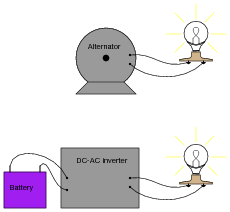
However, when measured by an analog voltmeter, the inverter’s output voltage is slightly greater than the alternator’s output voltage. Explain this discrepancy in measurements.
Reveal answerElectromechanical alternators naturally output sinusoidal waveforms. Many DC-AC inverters do not.
Notes:Remember, most analog meter movement designs respond to the average value of a waveform, not its RMS value. If the proportionality between a waveform’s average and RMS values ever change, the relative indications of a true-RMS instrument and an average-based (calibrated to read RMS) instrument will change as well.
-
Question 8 of 10
Is the deflection of an analog AC meter movement proportional to the peak, average, or RMS value of the waveform measured? Explain your answer.
Reveal answerAnalog meter deflection is proportional to the average value of the AC waveform measured, for most AC meter movement types. There are some meter movement designs, however, that give indications proportional to the RMS value of the waveform: hot-wire and electrodynamometer movements are of this nature.
Follow-up question: does this mean an average-responding meter movement cannot be calibrated to indicate in RMS units?
Challenge question: why do hot-wire and electrodynamometer meter movements provide true RMS indications, while most other movement designs indicate based on the signal’s average value?
Notes:Students often confuse the terms “average” and “RMS”, thinking they are interchangeable. Discuss the difference between these two terms, both mathematically and practically. While the concepts may seem similar at first, the details are actually quite different.
The question of whether an average-responding instrument can be calibrated to register in RMS units is very practical, since the vast majority of multimeters are calibrated this way. Because the proportionality between the average and RMS values of an AC waveform are dependent on the shape of the waveform, a certain wave-shape must be assumed in order to accurately calibrate an average-responding meter movement for RMS measurement. The assumed wave-shape, of course, is sinusoidal.
-
Question 9 of 10
In calculating the size of wire necessary to carry alternating current to a high-power load, which type of measurement is the best to use for current: peak, average, or RMS? Explain why.
Reveal answerRMS current is the most appropriate type of measurement for calculating wire size.
Notes:A clue to answering this question is this: what actually happens when the ampacity rating of a conductor is exceeded? Why, exactly, is over current a bad thing for conductors in general?
It is important for students to recognize the value of RMS measurements: why do we use them, and in what applications are they the most appropriate type of measurement to use in certain calculations? Ask your students what other applications might best use RMS voltage and current measurements as opposed to peak or average.





Hello, sorry but i doubt the asnwer to question #5, or at least i would ask for a better explanation.
For what i know, RMS amplitude of such a waveform is 1 x sqrt(0,5), while 0,5 seems to be average amplitude.