Facebook
 Google
 GitHub
 Linkedin
Analog Integrated Circuits
Performance-Based Assessments for Analog Integrated Circuit Competencies
33 questions By Tony R. Kuphaldt
-
Question 19 of 33
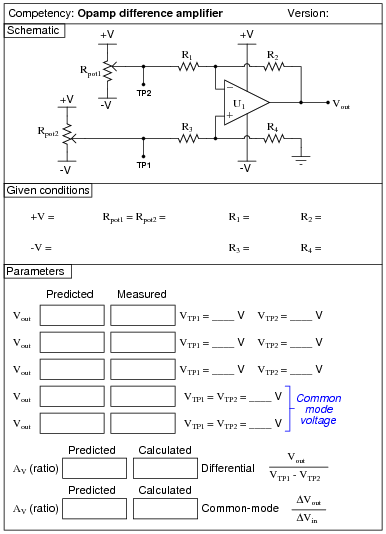
Reveal answerUse circuit simulation software to verify your predicted and measured parameter values.
Notes:Use a dual-voltage, regulated power supply to supply power to the opamp. Specify all four resistors as equal value, between 1 kΩ and 100 kΩ (1k5, 2k2, 2k7, 3k3, 4k7, 5k1, 6k8, 10k, 22k, 33k, 39k 47k, 68k, etc.). This will ensure a differential voltage gain of unity. If you want to have a different voltage gain, then by all means specify these resistor values however you see fit!
Differential gain is calculated by averaging the quotients of each measured Vout value with its respective Vin( ) − Vin(−) differential input voltage. Common-mode gain is calculated by dividing the difference in output voltages (∆Vout) by the difference in common-mode input voltages (∆Vin).
An extension of this exercise is to incorporate troubleshooting questions. Whether using this exercise as a performance assessment or simply as a concept-building lab, you might want to follow up your students’ results by asking them to predict the consequences of certain circuit faults.
-
Question 20 of 33
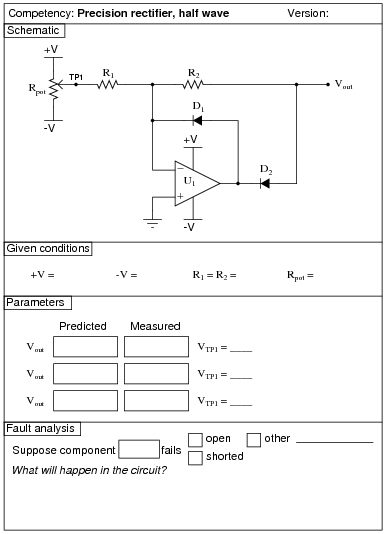
Reveal answerUse circuit simulation software to verify your predicted and measured parameter values.
Notes:Choose both positive input voltage values and negative input voltage values, so that students may predict and measure the output of this circuit under both types of conditions. The choice of diodes is not critical, as any rectifier diodes will work. The two resistor values should be equal, and at least as high as the potentiometer value. I recommend a 10 kΩ potentiometer and 15 kΩ resistors.
A good follow-up question to ask is what would be required to change the polarity of this half-wave precision rectifier circuit.
An extension of this exercise is to incorporate troubleshooting questions. Whether using this exercise as a performance assessment or simply as a concept-building lab, you might want to follow up your students’ results by asking them to predict the consequences of certain circuit faults.
-
Question 21 of 33

Reveal answerUse circuit simulation software to verify your predicted and measured parameter values.
Notes:Choose both positive input voltage values and negative input voltage values, so that students may predict and measure the output of this circuit under both types of conditions. The choice of diodes is not critical, as any rectifier diodes will work. All resistor values need to be equal, and at least as high as the potentiometer value. I recommend a 10 kΩ potentiometer and 15 kΩ resistors.
A good follow-up question to ask is what would be required to change the polarity of this full-wave precision rectifier circuit.
An extension of this exercise is to incorporate troubleshooting questions. Whether using this exercise as a performance assessment or simply as a concept-building lab, you might want to follow up your students’ results by asking them to predict the consequences of certain circuit faults.