Facebook
 Google
 GitHub
 Linkedin
Analog Integrated Circuits
Performance-Based Assessments for Analog Integrated Circuit Competencies
33 questions By Tony R. Kuphaldt
-
Question 16 of 33
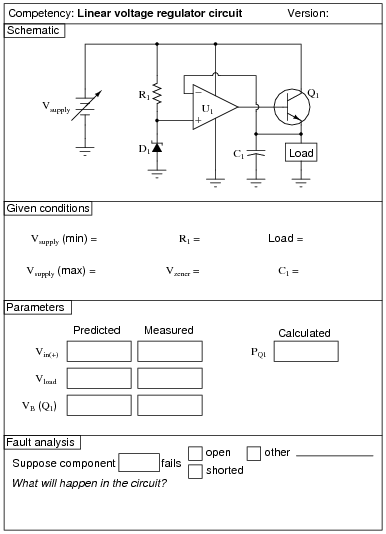
Reveal answerUse circuit simulation software to verify your predicted and measured parameter values.
Notes:Use a power transistor for this circuit, as general-purpose signal transistors may not have sufficient power dissipation ratings to survive the loading students may put them through! I recommend a small DC motor as a load. An electric motor offers an easy way to increase electrical loading by placing a mechanical load on the shaft. By doing this, students can see for themselves how well the circuit maintains load voltage (resisting voltage “sag” under increasing load current).
I have found that this circuit is excellent for getting students to understand how negative feedback really works. Here, the opamp adjusts the power transistor’s base voltage to whatever it needs to be in order to maintain the load voltage at the same level as the reference set by the zener diode. Any sort of loss incurred by the transistor (most notably VBE) is automatically compensated for by the opamp.
An extension of this exercise is to incorporate troubleshooting questions. Whether using this exercise as a performance assessment or simply as a concept-building lab, you might want to follow up your students’ results by asking them to predict the consequences of certain circuit faults.
-
Question 17 of 33
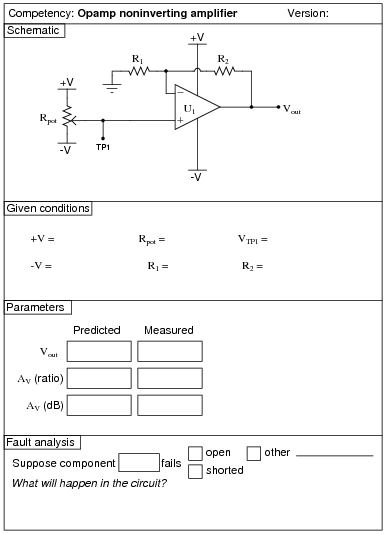
Reveal answerUse circuit simulation software to verify your predicted and measured parameter values.
Notes:Use a dual-voltage, regulated power supply to supply power to the opamp. Specify standard resistor values, all between 1 kΩ and 100 kΩ (1k5, 2k2, 2k7, 3k3, 4k7, 5k1, 6k8, 10k, 22k, 33k, 39k 47k, 68k, etc.).
I have had good success using the following values:
- V = 12 volts
- -V = -12 volts
- VTP1 = Any voltage well between V and -V not resulting in output saturation
- R1 = 10 kΩ
- R2 = 27 kΩ
- Rpot = 10 kΩ linear potentiometer
- U1 = TL081 BiFET operational amplifier (or one-half of a TL082)
An extension of this exercise is to incorporate troubleshooting questions. Whether using this exercise as a performance assessment or simply as a concept-building lab, you might want to follow up your students’ results by asking them to predict the consequences of certain circuit faults.
-
Question 18 of 33
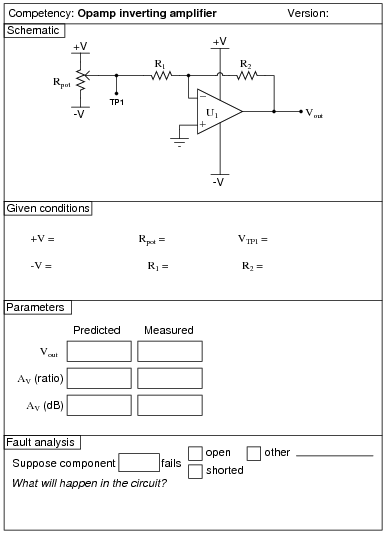
Reveal answerUse circuit simulation software to verify your predicted and measured parameter values.
Notes:Use a dual-voltage, regulated power supply to supply power to the opamp. Specify standard resistor values, all between 1 kΩ and 100 kΩ (1k5, 2k2, 2k7, 3k3, 4k7, 5k1, 6k8, 10k, 22k, 33k, 39k 47k, 68k, etc.).
I have had good success using the following values:
- V = 12 volts
- -V = -12 volts
- VTP1 = Any voltage well between V and -V not resulting in output saturation
- R1 = 10 kΩ
- R2 = 27 kΩ
- Rpot = 10 kΩ linear potentiometer
- U1 = TL081 BiFET operational amplifier (or one-half of a TL082)
An extension of this exercise is to incorporate troubleshooting questions. Whether using this exercise as a performance assessment or simply as a concept-building lab, you might want to follow up your students’ results by asking them to predict the consequences of certain circuit faults.