Facebook
 Google
 GitHub
 Linkedin
Digital Circuits
Performance-Based Assessments for Digital Circuit Competencies
43 questions By Tony R. Kuphaldt
-
Question 37 of 43

Reveal answerUse circuit simulation software to verify your predicted and actual truth tables.
Notes:Students are to research the datasheet for their particular IC and figure out from that what connections and timing sequences they need to make the circuit perform as requested. It is very important for students to learn to interpret manufacturers’ datasheets!
I recommend a slow clock frequency (1 Hz or so) to allow for easy viewing of the shift patterns. To conserve the number of necessary input switches, I allow students to hard-wire the data inputs (D0 through D3). This means they only need switches to control the mode of the shift register (parallel load, shift right, shift left, and shift inhibit).
-
Question 38 of 43
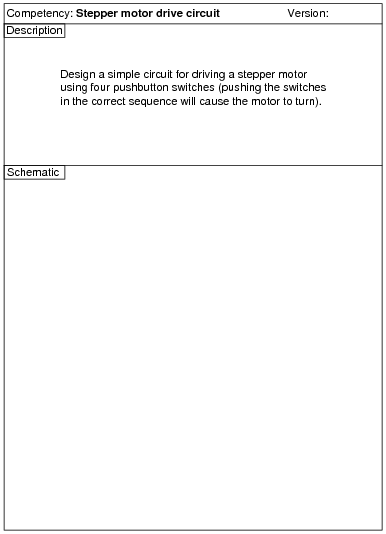
Reveal answerThe real circuit you build will validate your circuit design.
Notes:Use a four-pole, unipolar stepper motor for this assessment, with a power supply capable of sourcing the required current.
An extension of this exercise is to incorporate troubleshooting questions. Whether using this exercise as a performance assessment or simply as a concept-building lab, you might want to follow up your students’ results by asking them to predict the consequences of certain circuit faults.
-
Question 39 of 43

Reveal answerThe real circuit you build will validate your circuit design.
Notes:An extension of this exercise is to incorporate troubleshooting questions. Whether using this exercise as a performance assessment or simply as a concept-building lab, you might want to follow up your students’ results by asking them to predict the consequences of certain circuit faults.