Facebook
 Google
 GitHub
 Linkedin
Network Analysis Techniques
Simultaneous Equations for Circuit Analysis
25 questions By Tony R. Kuphaldt
-
Question 13 of 25
If we wish to solve for the value of three inter-related variables (i.e. x y z = 0), how many equations do we need in our “system” of simultaneous equations, total?
Graphically, what does the solution set (x,y,z) represent for a system of equations with three variables?
Reveal answerThree variables require three equations for solution. Graphically, the solution set represents the point at which three planes of infinite area intersect.
Notes:Ask your students to graphically contrast the scenario of three variables and three equations against two variables and two equations. Where is the solution set represented in a two-variable, two-equation system? How many we extrapolate from this situation to one where three variables and three equations are involved?
-
Question 14 of 25
Many circuit analysis techniques require the solution of “systems of linear equations,” sometimes called “simultaneous equations.” This question is really a series of practice problems for solving simultaneous linear equations, the purpose being to give you lots of practice using various solution techniques (including the solution facilities of your calculator).
Systems of two variables:
x + y = 5 x − y = −6 2x + y = 7 x − y = 1 2x − y = 4 x − y = 2 3x − 2y = −1 −10x + 2y = 0 3x − 5y = −13 5x + y = −6 −3x − 5y = −28 −x + 2y = 5 1000x − 500y = 0 −15000x + 2200y = −66200 9100x − 5000y = 24 550x + 2500y = 5550 7900x − 2800y = 28300 −5200x − 2700y = −6.5 Systems of three variables:
x − y z = 1 3x + 2y − 5z = −21 x + y + z = 0 −x − y + z = −1 x − 3y + z = 8 2x − y − 4z = −9 x + y + z = 3 −x − y − z = −12 −2x + 2y − z = 12 x + y − 2z = −12 −4x − 3y + 2z = −32 19x − 6y + 20z = −33 3x − 2y + z = 19 x − 2y + 3z = −1 4x + 5y − 3z = −17 −4x + 3y − 5z = −45 −2x + 7y − z = 3 −7x + 2y − 8z = 9 890x − 1000y + 2500z = −1500 2750x − 6200y + 4500z = 17500 3300x + 7200y − 5100z = 21500 −10000x + 5300y − 1000z = 8100 −x + y − z = 0 6x − 2y − 3z = 5 Reveal answerSystems of two variables:
x + y = 5 x − y = −6 2x + y = 7 x − y = 1 2x − y = 4 x − y = 2 x = 3 ; y = 2 x = 10 ; y = 16 x = 3 ; y = 1 3x − 2y = −1 −10x + 2y = 0 3x − 5y = −13 5x + y = −6 −3x − 5y = −28 −x + 2y = 5 x = −1 ; y = −1 x = 1 ; y = 5 x = −1 ; y = 2 1000x − 500y = 0 −15000x + 2200y = −66200 9100x − 5000y = 24 550x + 2500y = 5550 7900x − 2800y = 28300 −5200x − 2700y = −6.5 x = 1 ; y = 2 x = 5 ; y = 4 x = 0.001924 ; y = −0.001298 Systems of three variables:
x − y + z = 1 3x + 2y − 5z = −21 x + y + z = 0 −x − y + z = −1 x − 3y + z = 8 2x − y − 4z = −9 x + y + z = 3 −x − y − z = −12 −2x + 2y − z = 12 x = 1 ; y = 1 ; z = 1 x = 4 ; y = 1 ; z = 7 x = −3 ; y = 3 ; z = 0 x + y − 2z = −12 −4x − 3y + 2z = −32 19x − 6y + 20z = −33 3x − 2y + z = 19 x − 2y + 3z = −1 4x + 5y − 3z = −17 −4x + 3y − 5z = −45 −2x + 7y − z = 3 −7x + 2y − 8z = 9 x = 2 ; y = −4 ; z = 5 x = 6 ; y = 2 ; z = −1 x = −5 ; y = 3 ; z = 4 890x − 1000y + 2500z = −1500 2750x − 6200y + 4500z = 17500 3300x + 7200y − 5100z = 21500 −10000x + 5300y − 1000z = 8100 −x + y − z = 0 6x − 2y − 3z = 5 x = 2.215 ; y = 1.378 ; z = −0.8376 x = −5.171 ; y = −9.322 ; z = −5.794 Notes:I suggest you let your students discover how to use the equation-solving facilities of their scientific calculators on their own. My experience has been that students both young and old take to this challenge readily, because they realize learning how to use their calculators will save them a tremendous amount of hand calculations!
-
Question 15 of 25
Suppose you needed to choose a fixed resistor value (R) to make a voltage divider circuit, given a known potentiometer resistance value, the source voltage value, and the desired range of adjustment:
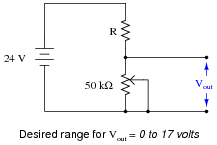
Solve for R, and show the equation you set up in order to do it.
Hint: remember the series resistor voltage divider formula . . .
$$V_R = V_{total} (\frac{R}{R_{total}})$$
Reveal answerR = 20.588 kΩ
Notes:Be sure to have your students set up their equations in front of the class so everyone can see how they did it. Some students may opt to apply Ohm’s Law to the solution of R, which is good, but for the purpose of developing equations to fit problems it might not be the best solution. Challenge your students to come up with a single equation that solves for R, with all known quantities on the other side of the “equal” sign.