Facebook
 Google
 GitHub
 Linkedin
Network Analysis Techniques
Simultaneous Equations for Circuit Analysis
25 questions By Tony R. Kuphaldt
-
Question 16 of 25
Suppose you needed to choose a potentiometer value (R) to make a voltage divider circuit, given a known fixed resistor value, the source voltage value, and the desired range of adjustment:
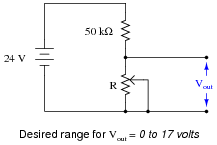
Solve for R, and show the equation you set up in order to do it.
Hint: remember the series resistor voltage divider formula . . .
$$V_R = V_{total} (\frac{R}{R_{total}})$$
Reveal answerR = 121.43 kΩ
Follow-up question: you will not be able to find a potentiometer with a full-range resistance value of exactly 121.43 kΩ. Describe how you could take a standard-value potentiometer and connect it to one or more fixed-value resistors to give it this desired full-scale range.
Notes:Be sure to have your students set up their equations in front of the class so everyone can see how they did it. Some students may opt to apply Ohm’s Law to the solution of R, which is good, but for the purpose of developing equations to fit problems it might not be the best solution. Challenge your students to come up with a single equation that solves for R, with all known quantities on the other side of the “equal” sign.
The follow-up question is very practical, as it is impossible to find potentiometers ready-made to arbitrary values of full-scale resistance. Instead, you must work with what you can find, which is usually nominal values such as 10 kΩ, 100 kΩ, 1 MΩ, etc.
-
Question 17 of 25
An engineer needs to calculate the values of two resistors to set the minimum and maximum resistance ratios for the following potentiometer circuit:
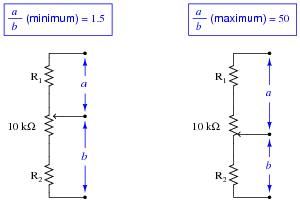
First, write an equation for each circuit, showing how resistances R1, R2, and the 10 kΩ of the potentiometer combine to form the ratio [a/b]. Then, use techniques for solving simultaneous equations to calculate actual resistance values for R1 and R2.
Reveal answera b(minimum) = R1 R2 + 10000a b(maximum) = R1 + 10000 R2R1 = 15.77 kΩ
R2 = 515.5 Ω
Notes:This very practical application of simultaneous equations was actually used by one of my students in establishing the lower and upper bounds for the voltage gain adjustment of an inverting opamp circuit!
-
Question 18 of 25
The voltage gain of a common-emitter transistor amplifier is approximately equal to the collector resistance divided by the emitter resistance:
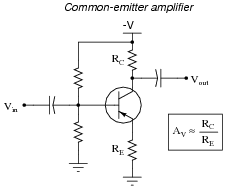
Knowing this, calculate the necessary resistance values for the following fixed-value resistor (R2) and potentiometer (R1) to give this common-emitter amplifier an adjustable voltage gain range of 2 to 8:

Reveal answerR1 (pot) = 9 kΩ
R2 (fixed) = 3 kΩ
Notes:Ask your students how they might make a standard-value potentiometer such as 10 kΩ have a full-scale (maximum) resistance of only 9 kΩ.