Facebook
 Google
 GitHub
 Linkedin
Network Analysis Techniques
Simultaneous Equations for Circuit Analysis
25 questions By Tony R. Kuphaldt
-
Question 22 of 25
Use simultaneous equations to calculate the values of R1 and R2 necessary to give this voltage divider the range of adjustment specified:

Vout (minimum) = 3 volts Vout (maximum) = 8 volts
R1 = R2 =
Reveal answerR1 = 2 kΩ
R2 = 3 kΩ
Notes:Have your students show their methods of solution in class, so you may observe their problem-solving ability and they may see multiple methods of solution.
-
Question 23 of 25
Use simultaneous equations to calculate the values of R1 and R2 necessary to give this voltage divider the range of adjustment specified:
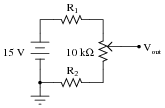
Vout (minimum) = 5 volts Vout (maximum) = 12 volts
R1 = R2 =
Reveal answerR1 = 4.2857 kΩ
R2 = 7.1429 kΩ
Notes:Have your students show their methods of solution in class, so you may observe their problem-solving ability and they may see multiple methods of solution.
-
Question 24 of 25
The voltage gain of an inverting operational amplifier circuit is defined by the ratio of feedback to input resistance:
AV = Rf Ri
Calculate the necessary values of R1 and R2 to limit the minimum and maximum voltage gain of this opamp circuit to 5 and 30, respectively, given a potentiometer in the middle with a full-span resistance of 5 kΩ:

Reveal answerR1 = 1.2 kΩ
R2 = 31 kΩ
Notes:This is a very practical example of using simultaneous equations in analog circuit design.