Facebook
 Google
 GitHub
 Linkedin
Digital Circuits
Switched Capacitor Circuitry
15 questions By Tony R. Kuphaldt
-
Question 1 of 15
Write an equation describing the precise mathematical relationship between electric charge (Q), capacitance (C), and voltage (V).
Reveal answerAll I’ll reveal here is that charge is directly proportional to both voltage and capacitance. This equation is an easy one to find on your own, by researching through various electronics textbooks!
Follow-up question: calculate the amount of charge stored in a 330 μF capacitor charged with a voltage of 12 volts.
Notes:This is one of those equations usually discussed somewhere in the first few months of basic electronics education, and promptly forgotten by most. It can be very useful, however, when dealing with charge pumps and other switched-capacitor circuitry.
-
Question 2 of 15
What would happen if a 10 μF capacitor, charged to a voltage of 6 volts, were connected to a completely discharged (0 volts) 22 μF capacitor?
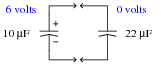
What would the voltage(s) be across each capacitor, after enough time had passed for complete equalization to occur?
Reveal answerVoltage across each capacitor = 1.875 volts.
Notes:The most important aspect of your students’ answers is how they arrived at them. There is more than one way to solve this problem!
-
Question 3 of 15
What would happen to the voltage across capacitor C2 if the following steps were followed, over and over again:

- Connect capacitor C1 to battery, allow to fully charge
- Disconnect capacitor C1 from battery
- Connect capacitor C1 to capacitor C2, allow for charges to equalize
- Disconnect capacitor C1 from capacitor C2
- Repeat
Reveal answerEventually, the voltage across capacitor C2 would be equal to the battery voltage.
Challenge question: how do the relative sizes of the capacitors (in Farads) affect this process? For example, what if C1 = 10 μF and C2 = 470 μF? Or, what if C1 = 330 μF and C2 = 2.2 μF? Explain your answer.
Notes:This question previews flying capacitor circuits.