
 Facebook
 Google
 GitHub
 Linkedin
Network Analysis Techniques
Thevenin’s, Norton’s, and Maximum Power Transfer Theorems
46 questions By Tony R. Kuphaldt
-
Question 25 of 46
A practical current source may be built using a battery and a special semiconductor component known as a current-limiting diode:

The current-limiting diode acts as a variable resistance, to regulate current through it at a constant value: if current increases, its resistance increases to reduce the current back to where it should be; if current decreases, its resistance decreases to increase current up to where it should be.
Determine the amount of voltage output by an open-circuited (ideal) current source. Contrast this with the voltage output by the practical current source shown in the diagram. Finally, draw an equivalent circuit showing an ideal current source somehow connected to a resistance in such a way that its open-circuited output voltage is identical to the practical current source.
Reveal answerAn ideal current source outputs infinite voltage when open-circuited. The practical current source shown in the diagram outputs 24 volts.
Equivalent circuit:

Follow-up question: the more “ideal” a current source is, the (choose one: greater, or less) its internal resistance will be. Compare this with the internal resistance of an ideal voltage source.
Notes:A point of difficulty with some students is the word infinite. I have found it surprisingly common for students to confuse the concept “infinite” with the concept “infinitesimal”. If any of your students are confused in the same manner, it will become evident when they try to explain the open-circuit output voltage of an ideal current source.
-
Question 26 of 46
Electrochemical batteries are supposed to act as constant voltage sources, outputting an unchanging voltage for a wide range of load currents. The output voltage of real batteries, though, always “sags” to some degree under the influence of a load.
Explain why this is so, in terms of modeling the battery as an ideal voltage source combined with a resistance. How do you suggest the internal resistance of a chemical battery be experimentally measured?
Reveal answer
I’ll let you figure out how to measure this internal resistance!
Notes:Although real chemical batteries do not respond as simply as this equivalent circuit would suggest, the model is accurate enough for many purposes.
-
Question 27 of 46
Load lines are special types of graphs used in electronics to characterize the output voltage and current behavior of different power sources:
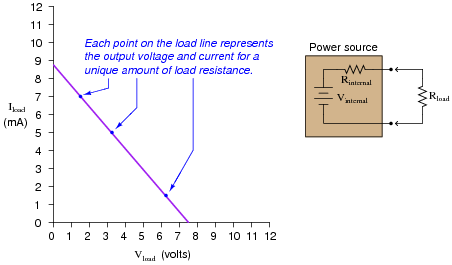
If we know that all the internal components of a power source are inherently linear, we know that the load line plot will indeed by a straight line. And, if we know the plot will be a straight line, all we need in order to plot a complete load line are two data points.
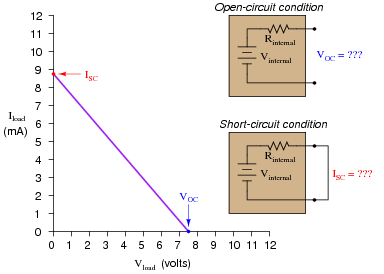
Usually, the easiest data points to gather for a circuit - whether it be a real circuit or an hypothetical circuit existing on paper only - is the open-circuit condition and the short-circuit condition. In other words, we see how much voltage the source will output with no load connected (Iload = 0 milliamps) and then we see how much current the source will output into a direct short (Vload = 0 volts):
Suppose we have two differently-constructed power sources, yet both of these sources share the same open-circuit voltage (VOC) and the same short-circuit current (ISC). Assuming the internal components of both power sources are linear in nature, explain how we would know without doubt that the two power sources were electrically equivalent to one another. In other words, explain how we would know just from the limited data of VOC and ISC that these two power sources will behave exactly the same when connected to the same load resistance, whatever that load resistance may be.
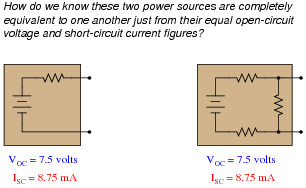
Reveal answerWith equal VOC and ISC figures and with linear componentry, the load lines must be identical. This means that any load resistance, when connected to each of the power sources, will experience the exact same voltage and current.
Notes:This is a “poor man’s proof” of Thévenin’s and Norton’s theorems: that we may completely characterize a power source in a simple, equivalent circuit by finding the original circuit’s open-circuit voltage and short-circuit current. The assumption of linearity allows us to define the load line for each power source from just these two data points.







I think there is an error in 8th question, Thevenin’s resistance must be 479.53 and not 210.53
There is another mistake in question 39:
“this student’s power source circuit resembles a 3 volt source in series with a 5 kΩ resistance”—should be 2.5 kΩ resistance