
 Facebook
 Google
 GitHub
 Linkedin
Network Analysis Techniques
Thevenin’s, Norton’s, and Maximum Power Transfer Theorems
46 questions By Tony R. Kuphaldt
-
Question 22 of 46
Calculate the voltage dropped across the load resistor, and the current through the load resistor, for the following load resistance values in this circuit:
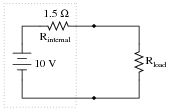
Rload Eload Iload
1 k Ω
2 k Ω
5 k Ω
8 k Ω
10 k Ω
Do the “boxed” components in this circuit behave more like a constant voltage source, or a constant current source? Explain your answer.Reveal answerI’ll let you do the calculations on your own! Hint: there is a way to figure out the answer without having to calculate all five load resistance scenarios.
Follow-up question: would you say that voltage sources are typically characterized as having high internal resistances or low internal resistances? What about current sources? Explain your answers.
Notes:Ask your students to make a general prediction about the internal resistance of voltage sources. Based on our calculations in this circuit, would you expect voltage sources to have high internal resistance or low internal resistance? Also ask what constitutes a “high” or a “low” internal resistance for a power source. Is this a relative determination, or an absolute determination?
-
Question 23 of 46
Calculate the voltage dropped across the load resistor, and the current through the load resistor, for the following load resistance values in this circuit:
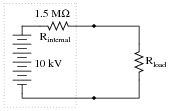
Rload Eload Iload
1 k Ω
2 k Ω
5 k Ω
8 k Ω
10 k Ω
Do the “boxed” components in this circuit behave more like a constant voltage source, or a constant current source? Explain your answer.Reveal answerI’ll let you do the calculations on your own! Hint: there is a way to figure out the answer without having to calculate all five load resistance scenarios.
Follow-up question #1: would you say that voltage sources are typically characterized as having high internal resistances or low internal resistances? What about current sources? Explain your answers.
Follow-up question #2: although it is difficult to find real devices that approximate ideal current sources, there are a few that do. An AC device called a “current transformer” is one of them. Describe which scenario would be the safest from a perspective of shock hazard: an open-circuited current transformer, or a shirt-circuited current transformer. Why is this?
Notes:Ask your students to make a general prediction about the internal resistance of current sources. Based on our calculations in this circuit, would you expect voltage sources to have high internal resistance or low internal resistance? Also ask what constitutes a “high” or a “low” internal resistance for a power source. Is this a relative determination, or an absolute determination?
-
Question 24 of 46
In the following circuit, an adjustable voltage source is connected in series with a resistive load and another voltage source:

Determine what will happen to the current in this circuit if the adjustable voltage source is increased.
In this next circuit, an adjustable voltage source is connected in series with a resistive load and a current source:

Now determine what will happen to the current in this second circuit if the adjustable voltage source is increased.
One way to define electrical resistance is by comparing the change in applied voltage (∆V) to the change in resultant current (∆I). This is mathematically expressed by the following ratio:
$$R= \frac{\triangle V}{\triangle I}$$
From the perspective of the adjustable voltage source (Vadjust), and as defined by the above equation, which of these two circuits has the greatest resistance? What does this result suggest about the equivalent resistance of a constant-voltage source versus the equivalent resistance of a constant-current source?
Reveal answerIn the first circuit, current will increase as Vadjust is increased, yielding a finite total resistance. In the second circuit, current will remain constant as Vadjust is increased, yielding an infinite total resistance.
Follow-up question: calculate R as defined by the formula \(\frac{\triangle V}{\triangle I}\) for these two circuits, assuming Vadjust changes from 15 volts to 16 volts (1 volt ∆V):

Notes:If students are unable to analyze the two circuits qualitatively as suggested in the question, the follow-up question should clear things up. The point of all this, of course, is for students to see that a constant voltage source has zero internal resistance and that a constant current source has infinite internal resistance.
In case anyone should ask, the proper definition for resistance is expressed as a derivative. That is, instead of \(R=\frac{\triangle V}{\triangle I}\) we should have \(R=\frac{dV}{dI}\).



I think there is an error in 8th question, Thevenin’s resistance must be 479.53 and not 210.53
There is another mistake in question 39:
“this student’s power source circuit resembles a 3 volt source in series with a 5 kΩ resistance”—should be 2.5 kΩ resistance