
 Facebook
 Google
 GitHub
 Linkedin
Network Analysis Techniques
Thevenin’s, Norton’s, and Maximum Power Transfer Theorems
46 questions By Tony R. Kuphaldt
-
Question 34 of 46
Use Thévenin’s Theorem to determine a simple equivalent circuit for the 10 volt source, the 5 kΩ resistor, and the 2.2 kΩ resistor; then calculate the voltage across the 1 kΩ load:
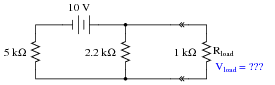
This exercise may seem pointless, as it is easy enough to obtain the answer simply by series-parallel analysis of this circuit. However, there is definite value in determining a Thévenin equivalent circuit for the voltage source, 5 kΩ resistor, and 2.2 kΩ resistor if the load voltage for several different values of load resistance needs to be predicted. Explain why Thévenin’s Theorem becomes the more efficient way to predict load voltage if multiple load resistor values are considered.
Reveal answerVload = 1.209 volts
Notes:Ask your students to show how (step-by-step) they arrived at the equivalent circuit, prior to calculating load voltage.
In case students are unfamiliar with the “double-chevron” symbols in the schematic diagram, let them know that these represent male/female connector pairs.
-
Question 35 of 46
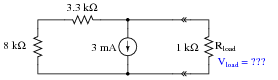
Use Thévenin’s Theorem to determine a simple equivalent circuit for the 3 mA source, the 8 kΩ resistor, and the 3.3 kΩ resistor; then calculate the voltage across the 1 kΩ load:
Reveal answerVload = 2.756 volts
Follow-up question: although analyzing this circuit by series-parallel analysis is probably easier than using Thévenin’s Theorem, there is definite value to doing it the way this question instructs when considering many different load resistance possibilities. Explain why this is.
Notes:Ask your students to show how (step-by-step) they arrived at the equivalent circuit, prior to calculating load voltage.
In case students are unfamiliar with the “double-chevron” symbols in the schematic diagram, let them know that these represent male/female connector pairs.
-
Question 36 of 46
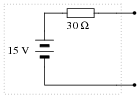
Convert the following Thévenin equivalent circuit into a Norton equivalent circuit:
Reveal answer
Notes:Nothing special here, just practice converting between Thevenin and Norton sources. Be sure to ask your students to explain all their steps and reasoning in arriving at the answer.







I think there is an error in 8th question, Thevenin’s resistance must be 479.53 and not 210.53
There is another mistake in question 39:
“this student’s power source circuit resembles a 3 volt source in series with a 5 kΩ resistance”—should be 2.5 kΩ resistance