
 Facebook
 Google
 GitHub
 Linkedin
Network Analysis Techniques
Thevenin’s, Norton’s, and Maximum Power Transfer Theorems
46 questions By Tony R. Kuphaldt
-
Question 19 of 46
Give a step-by-step procedure for reducing this circuit to a Thévenin equivalent circuit (one voltage source in series with one resistor):

Reveal answerI will let you research the procedure for determining Thévenin equivalent circuits, and explain it in your own words. Here is the equivalent circuit for the circuit given in the question:

Notes:It should be easy for your students to research an algorithm (step-by-step procedure) for determining a Thévenin equivalent circuit. Let them do the work, and explain it to you and their classmates!
-
Question 20 of 46
Suppose you were handed a black box with two metal terminals on one side, for attaching electrical (wire) connections. Inside this box, you were told, was a current source connected in parallel with a resistance.

Your task was to experimentally determine the values of the current source and the resistor inside the box, and you did just that. From your experimental data you then sketched a circuit with the following component values:
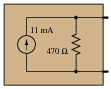
However, you later discovered that you had been tricked. Instead of containing a current source and a resistor, the circuit inside the box was actually a voltage source connected in series with a resistor:
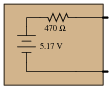
Demonstrate that these two different circuits are indistinguishable from the perspective of the two metal terminals, and explain what general principle this equivalence represents.
Reveal answerA good way to demonstrate the electrical equivalence of these circuits is to calculate their responses to identical load resistor values. The equivalence you see here proves that Thévenin and Norton equivalent circuits are interchangeable.
Follow-up question: give a step-by-step procedure for converting a Thévenin equivalent circuit into a Norton equivalent circuit, and visa-versa.
Notes:Ask your students to clearly state both Thévenin’s and Norton’s Theorems, and also discuss why both these theorems are important electrical analysis tools.
-
Question 21 of 46
An AC voltage source with an internal (“Thévenin”) resistance of 50 Ω is connected to a step-down transformer with a winding ratio of 10:1. What is the equivalent source voltage and resistance, as seen from the load terminals?

Reveal answerEquivalent source voltage = 2.4 VAC; equivalent source resistance = 0.5 Ω.
Notes:Ask your students to explain how they obtained the equivalent voltage and current figures for this transformer-coupled source. Is there a scenario we could imagine the source being placed in that would allow us to obtain these figures without knowing anything about transformer impedance matching?






I think there is an error in 8th question, Thevenin’s resistance must be 479.53 and not 210.53
There is another mistake in question 39:
“this student’s power source circuit resembles a 3 volt source in series with a 5 kΩ resistance”—should be 2.5 kΩ resistance