
 Facebook
 Google
 GitHub
 Linkedin
Network Analysis Techniques
Thevenin’s, Norton’s, and Maximum Power Transfer Theorems
46 questions By Tony R. Kuphaldt
-
Question 16 of 46
Suppose you were handed a black box with two metal terminals on one side, for attaching electrical (wire) connections. Inside this box, you were told, was a voltage source (an ideal voltage source connected in series with a resistance):
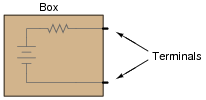
How would you experimentally determine the voltage of the ideal voltage source inside this box, and how would you experimentally determine the resistance of the series resistor? By “experimentally,” I mean determine voltage and resistance using actual test equipment rather than assuming certain component values (remember, this “black box” is sealed, so you cannot look inside!).
Reveal answerMeasure the open-circuit voltage between the two terminals, and then measure the short-circuit current. The voltage source’s value is measured, while the resistor’s value is calculated using Ohm’s Law.
Notes:Ask your students how they would apply this technique to an abstract circuit problem, to reduce a complex network of sources and resistances to a single voltage source and single series resistance (Thévenin equivalent).
-
Question 17 of 46
Suppose you were handed a black box with two metal terminals on one side, for attaching electrical (wire) connections. Inside this box, you were told, was a current source (an ideal current source connected in parallel with a resistance):
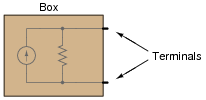
How would you experimentally determine the current of the ideal current source inside this box, and how would you experimentally determine the resistance of the parallel resistor? By “experimentally,” I mean determine current and resistance using actual test equipment rather than assuming certain component values (remember, this “black box” is sealed, so you cannot look inside!).
Reveal answerMeasure the open-circuit voltage between the two terminals, and then measure the short-circuit current. The current source’s value is measured, while the resistor’s value is calculated using Ohm’s Law.
Notes:Ask your students how they would apply this technique to an abstract circuit problem, to reduce a complex network of sources and resistances to a single current source and single parallel resistance (Norton equivalent).
-
Question 18 of 46
Suppose you were handed a black box with two metal terminals on one side, for attaching electrical (wire) connections. Inside this box, you were told, was a voltage source connected in series with a resistance.

Your task was to experimentally determine the values of the voltage source and the resistor inside the box, and you did just that. From your experimental data you then sketched a circuit with the following component values:
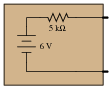
However, you later discovered that you had been tricked. Instead of containing a single voltage source and a single resistance, the circuit inside the box actually looked like this:
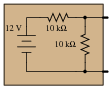
Demonstrate that these two different circuits are indistinguishable from the perspective of the two metal terminals, and explain what general principle this equivalence represents.
Reveal answerA good way to demonstrate the electrical equivalence of these circuits is to calculate their responses to identical load resistor values. The equivalence you see here is an application of Thévenin’s Theorem.
Notes:Ask your students to clearly state Thévenin’s Theorem, and explain how it may be applied to the two-resistor circuit to obtain the one-resistor circuit.



I think there is an error in 8th question, Thevenin’s resistance must be 479.53 and not 210.53
There is another mistake in question 39:
“this student’s power source circuit resembles a 3 volt source in series with a 5 kΩ resistance”—should be 2.5 kΩ resistance