
 Facebook
 Google
 GitHub
 Linkedin
Network Analysis Techniques
Thevenin’s, Norton’s, and Maximum Power Transfer Theorems
46 questions By Tony R. Kuphaldt
-
Question 31 of 46
An electric arc welder is a low-voltage, high-current power source used to generate hot arcs capable of melting metal. Note the voltage and current measurements taken for this particular welder:
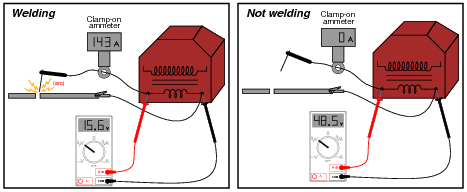
Determine two Thévenin equivalent circuits for the arc welder. The first circuit will simply be an AC voltage source and an internal impedance. The second circuit will be a voltage source and internal impedance connected through an ideal transformer with a step-down ratio of 8 to 1:
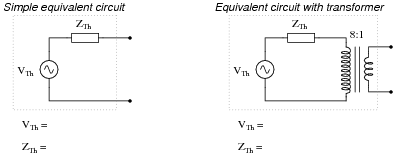
Reveal answerSimple equivalent circuit
VTh = 48.5 volts
ZTh = 0.230 Ω
Equivalent circuit with transformer
VTh = 388 volts
ZTh = 14.72 Ω
Notes:This practical scenario shows how Thévenin’s theorem may be used to “model” a complex device as two simple components (voltage source and resistor). Of course, we must make certain assumptions when modeling in this fashion: we assume, for instance, that the arc welder is a linear device, which may or may not be true.
-
Question 32 of 46
Is it possible to regard this complex network of power sources and resistances as a simple voltage source (one ideal voltage source in series with an internal resistance), or as a simple current source (one ideal current source in parallel with an internal resistance)? Why or why not?

Reveal answerYes, because all the constituent components are linear and bilateral.
Follow-up question: why would anyone want to represent this complex network as either a simple voltage source or a simple current source?
Notes:Ask your students what it means for an electrical or electronic component to be considered “linear,” and also what it means to be considered “bilateral.” Can they give examples of components that are nonlinear, and/or unilateral?
-
Question 33 of 46
Give a step-by-step procedure for “Nortonizing” any circuit: finding the Norton equivalent current (VNorton) and Norton equivalent resistance (RNorton).
- Step #1:
- Step #2:
Reveal answerThis is easy enough for you to look up in any electronics textbook. I’ll leave you to it!
Follow-up question: describe the difference in how one must consider voltage sources versus current sources when calculating the equivalent circuit’s resistance (RNorton) of a complex circuit containing both types of sources?
Notes:I really mean what I say here about looking this up in a textbook. Norton’s Theorem is a very well-covered subject in many books, and so it is perfectly reasonable to expect students will do this research on their own and come back to class with a complete answer.
The follow-up question is very important, because some circuits (especially transistor amplifier circuits) contain both types of sources. Knowing how to consider each one in the process of calculating the Norton equivalent resistance for a circuit is very important. When performing this analysis on transistor amplifiers, the circuit often becomes much simpler than its original form with all the voltage sources shorted and current sources opened!





I think there is an error in 8th question, Thevenin’s resistance must be 479.53 and not 210.53
There is another mistake in question 39:
“this student’s power source circuit resembles a 3 volt source in series with a 5 kΩ resistance”—should be 2.5 kΩ resistance