Facebook
 Google
 GitHub
 Linkedin
Discrete Semiconductor Devices and Circuits
Thyristor Application Circuits
16 questions By Tony R. Kuphaldt
-
Question 7 of 16
Optically-isolated TRIACs are available for use as solid-state relays, suitable for replacing electromechanical relays in many AC power switching applications:
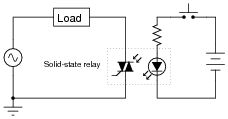
Describe some of the advantages of using a solid-state relay for switching AC power instead of using an electromechanical relay as shown here:
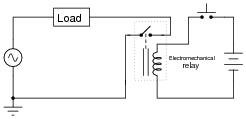
Also describe any disadvantages to using a solid-state relay, if they exist.
Reveal answer- Advantages
- Less DC drive current required
- No moving parts to wear
- Zero-crossing turn-off naturally provided by the TRIAC
- Any others you can think of . . . ?
- Disadvantages
- •“Off” state not as high-impedance as an electromechanical relay
- •Susceptible to [dv/dt]-induced turn-on
- •Any others you can think of . . . ?
Follow-up question: what is zero-crossing turn-off, and what type of load might benefit most from this feature?
-
Question 8 of 16
Predict how the operation of this AC power control circuit will be affected as a result of the following faults. Consider each fault independently (i.e. one at a time, no multiple faults):
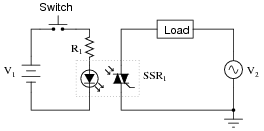
- Switch contacts fail open:
- Switch contacts fail shorted:
- Resistor R1 fails open:
- Solder bridge (short) past resistor R1:
- Battery (V1) dies:
For each of these conditions, explain why the resulting effects will occur.
Reveal answer- Switch contacts fail open: Load never receives power.
- Switch contacts fail shorted: Load always receives power.
- Resistor R1 fails open: Load never receives power.
- Solder bridge (short) past resistor R1: Load energizes momentarily the first time the switch is actuated, then refuses to turn on after the LED inside the solid-state relay (SSR1) becomes damaged.
- Battery (V1) dies: Load never receives power.
Notes:The purpose of this question is to approach the domain of circuit troubleshooting from a perspective of knowing what the fault is, rather than only knowing what the symptoms are. Although this is not necessarily a realistic perspective, it helps students build the foundational knowledge necessary to diagnose a faulted circuit from empirical data. Questions such as this should be followed (eventually) by other questions asking students to identify likely faults based on measurements.
-
Question 9 of 16
This TRIAC circuit has a serious problem. Whenever the pushbutton switch is actuated, the TRIAC explodes!
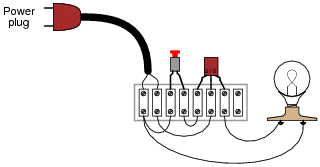
Explain why this happens, and what must be done to fix the problem.
Reveal answerToo much triggering voltage is being applied to the TRIAC in this configuration. I’ll let you determine how to re-wire the circuit to avoid this problem!
Notes:I’ve seen students do this a few times, with startling results!