Facebook
 Google
 GitHub
 Linkedin
Discrete Semiconductor Devices and Circuits
Thyristor Application Circuits
16 questions By Tony R. Kuphaldt
-
Question 10 of 16
Suppose a student builds the following TRIAC circuit and finds that it does not work:
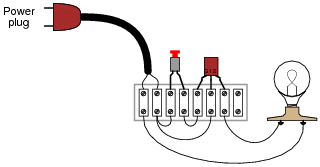
When the pushbutton switch is actuated, nothing happens. What is wrong with this circuit? Hint: the problem in this circuit is very subtle, and may be very difficult to discern.
Reveal answerTerminals MT1 and MT2 on the TRIAC need to be reversed, like this:

Notes:This aspect of TRIACs is often omitted from texts on thyristor devices, but it is important for students to understand. Even though TRIACs are bilateral devices, it still does matter where the triggering voltage is applied (between Gate and MT1, versus Gate and MT2).
-
Question 11 of 16
A student builds this simple TRIAC power control circuit to dim a light bulb:
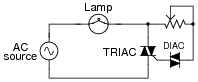
The only problem with it is the lack of full control over the light bulb’s brightness. At one extreme of the potentiometer’s range, the light bulb is at full brightness. As the potentiometer is moved toward the direction of dimming, though, the light bulb approaches a medium level of intensity, then suddenly de-energizes completely. In other words, this circuit is incapable of providing fine control of power from “off” to “full” light. The range of control seems to be from full brightness to half-brightness, and nothing below that.
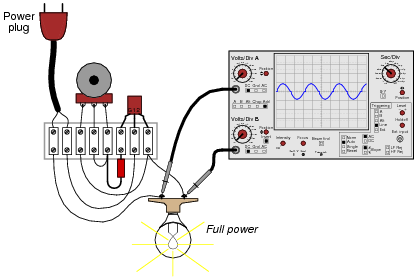
Connecting an oscilloscope across the light bulb terminals (using both channels of the oscilloscope to measure voltage drop in the “differential” mode), the waveform looks like this at full power:
When the potentiometer is adjusted to the position giving minimum light bulb brightness (just before the light bulb completely turns off), the waveform looks like this:
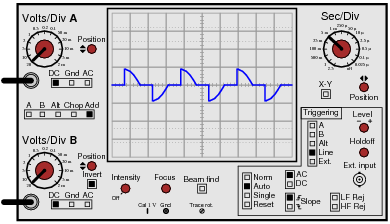
Explain why this circuit cannot provide continuous adjustment of light bulb brightness below this level.
Reveal answerThe TRIAC’s triggering is based on amplitude of the power source sine wave only. At minimum (adjustable) power, the TRIAC triggers exactly at the sine wave’s peak, then latches on until the load current crosses zero. A shorter waveform duty cycle is simply not possible with this scheme because there is no way to trigger the TRIAC at a point past the sine wave peak.
Follow-up question #1: which direction must the student rotate the potentiometer shaft (CW or CCW) in order to dim the lamp, based on the pictorial diagram shown in the question?
Follow-up question #2: explain how the oscilloscope is being used by the student, with two probes, channel B inverted, and the “Add” function engaged. Why is this mode of usage important for this kind of voltage measurement?
Notes:Some students find this concept difficult to grasp, so it may be necessary to discuss what the load power waveforms appear like at different power settings.
-
Question 12 of 16
Predict how the operation of this AC lamp dimmer circuit will be affected as a result of the following faults. Consider each fault independently (i.e. one at a time, no multiple faults):
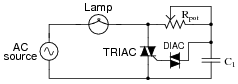
- Potentiometer Rpot fails open:
- Capacitor C1 fails shorted:
- Capacitor C1 fails open:
- DIAC fails open:
- TRIAC fails shorted:
For each of these conditions, explain why the resulting effects will occur.
Reveal answer- Potentiometer Rpot fails open: Lamp remains off.
- Capacitor C1 fails shorted: Lamp remains off.
- Capacitor C1 fails open: Range of lamp brightness control extends from 100% to 50%, and any attempt to make it dimmer results in the lamp just turning all the way off.
- DIAC fails open: Lamp remains off.
- TRIAC fails shorted: Lamp remains on at 100% brightness.
Notes:The purpose of this question is to approach the domain of circuit troubleshooting from a perspective of knowing what the fault is, rather than only knowing what the symptoms are. Although this is not necessarily a realistic perspective, it helps students build the foundational knowledge necessary to diagnose a faulted circuit from empirical data. Questions such as this should be followed (eventually) by other questions asking students to identify likely faults based on measurements.