
 Facebook
 Google
 GitHub
 Linkedin
DC Electric Circuits
Time Constant Calculations
52 questions By Tony R. Kuphaldt
-
Question 10 of 52
Qualitatively determine the voltages across all components as well as the current through all components in this simple LR circuit at three different times: (1) just before the switch closes, (2) at the instant the switch contacts touch, and (3) after the switch has been closed for a long time.
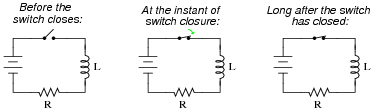
Express your answers qualitatively: “maximum,” “minimum,” or perhaps “zero” if you know that to be the case.
Before the switch closes:
VL =
VR =
Vswitch =
I =
At the instant of switch closure:
VL =
VR =
Vswitch =
I =
Long after the switch has closed:
VL =
VR =
Vswitch =
I =
Hint: a graph may be a helpful tool for determining the answers!
Reveal answerBefore the switch closes:
VL = zero
VR = zero
Vswitch = maximum
I = zero
At the instant of switch closure:
VL = maximum
VR = zero
Vswitch = zero
I = zero
Long after the switch has closed:
VL = zero
VR = maximum
Vswitch = zero
I = maximum
Follow-up question: which of these variables remained the same immediately before and immediately after switch closure? Explain why.
Notes:The purpose of this question is to preview the concept of “initial” and “final” values in RC circuits, before they learn to use the “universal time constant formula.”
-
Question 11 of 52
Calculate the final value of current through the inductor with the switch in the left-hand position (assuming that many time constants’ worth of time have passed):

Now, assume that the switch is instantly moved to the right-hand position. How much voltage will the inductor initially drop?
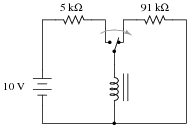
Explain why this voltage is so very different from the supply voltage. What practical uses might a circuit such as this have?
Reveal answerIswitch−left = 2 mA
Vswitch−right = 182 V
Follow-up question: suppose this circuit were built and tested, and it was found that the voltage developed across the inductor at the moment the switch moved to the right-hand position far exceeded 182 volts. Identify some possible problems in the circuit which could account for this excessive voltage.
Notes:The main purpose of this question is to get students thinking in terms of “initial” and “final” values for LR circuits, and how one might calculate them. It is largely a conceptual question, with just a bit of calculation necessary.
One practical application of this circuit is for “stepping up” DC voltage. The circuit topology shown in the question is that of an inverting converter circuit. This form of DC-DC converter circuit has the ability to step voltage up or down, depending on the duty cycle of the switch’s oscillation.
-
Question 12 of 52
An unfortunate tendency that many new students have is to immediately plug numbers into equations when faced with a time-constant circuit problem, before carefully considering the circuit. Explain why the following steps are very wise to follow before performing any mathematical calculations:
- Step 1: Identify and list all the known (“given”) quantities.
- Step 2: Draw a schematic of the circuit, if none is given to you.
- Step 3: Label components in the schematic with all known quantities.
- Step 4: Sketch a rough plot of how you expect the variable(s) in the circuit to change over time.
- Step 5: Label starting and final values for these graphed variables, wherever possible.
Reveal answerI’ll let you discuss this question with your classmates and instructor!
Notes:This is advice I always give my students, after seeing so many students get themselves into trouble by blindly plugging numbers into equations. Think before you act, is the motto here!
Actually, this general advice applies to most all physics-type problems: identify what it is you’re trying to solve and what you have to work with before jumping into calculations.



Maybe this will help someone else. The general formulas for V(t) and I(t) in question 25 (and the x(t) versions in question s 23 and 14) contain typos (or maybe hypertext coding glitches). They should actually be V(t) = (Vf-Vo)(1-e^(-t/𝛕)) + Vo, I(t) = (If-Io)(1-e^(-t/𝛕)) + Io in question 25. Those are correct in the PDF download version. In questions 23 and 24 the equations are x = xinitial + ( xfinal − xinitial ) ( 1 − e[(−t)/(τ)] ).