Facebook
 Google
 GitHub
 Linkedin
Analog Devices Intros Open-Source MLPlugin to Its Code Fusion Toolset
The AutoML tool promises to fast-track edge AI deployment in constrained hardware platforms.
Analog Devices recently announced the general availability of AutoML for Embedded, an open-source Visual Studio Code plugin for accelerating edge AI development. Co-developed with Antmicro and integrated into ADI’s CodeFusion Studio, the tool is meant to simplify the machine learning workflow for embedded developers, with a special focus on those working with resource-limited microcontrollers.
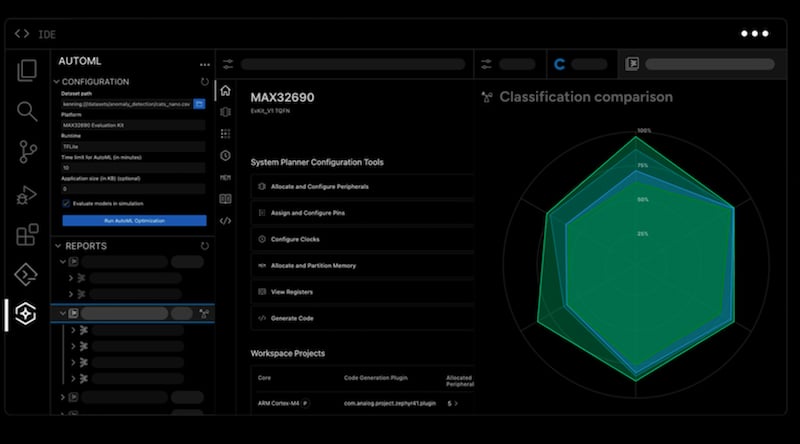
The AutoML for Embedded user interface. Image used courtesy of Analog Devices
The greatest challenge of developing intelligent edge devices lies in fitting sophisticated ML models onto hardware with strict memory and compute constraints. Tasks like architecture tuning and deployment-specific optimization often require deep ML expertise. ADI designed its new plugin to tear down these barriers by automating the full machine learning pipeline while remaining hardware-agnostic and open-source.
AutoML for Embedded
AutoML for Embedded integrates tightly with ADI’s CodeFusion Studio and targets deployment on edge AI microcontrollers, specifically launching with support for ADI’s MAX78002 and MAX32690. The tool leverages the Kenning framework to abstract hardware specifics. It is compatible with both Renode-based simulations and Zephyr RTOS environments so developers can prototype and evaluate models in real time.
At its most basic, the plugin automates model search and optimization based on a combination of sequential model-based algorithm configuration (SMAC) and hyperband with successive halving. With a hybrid approach, AutoML efficiently allocates training resources to promising candidates while considering a range of architectures and hyperparameters. The pipeline includes model validation that ensures the final model conforms to the strict memory limits imposed by the target edge device.
Beyond optimization, the tool also provides benchmarking and performance analytics via Kenning’s reporting tools. These include quantifiable metrics on inference speed, memory footprint, and accuracy that help designers select the best model for specific deployment constraints.
A Case for Automated Model Optimization
Manually tuning machine learning models for embedded systems is a notoriously labor-intensive and technically demanding process, involving hardware constraints and an expansive parameter search space. Embedded platforms often feature limited RAM, non-volatile storage, and compute resources, which means that even moderately complex models designed for desktop or cloud environments must be significantly pruned or restructured before deployment.
At the same time, tuning hyperparameters like learning rate, batch size, optimizer choice, and regularization strength requires deep domain knowledge and extensive experimentation. Each permutation must be trained and validated and often involves time-consuming trial-and-error cycles. For embedded deployments, tuning can minimize memory footprint, inference latency, and power consumption—all of which conflict with one another.
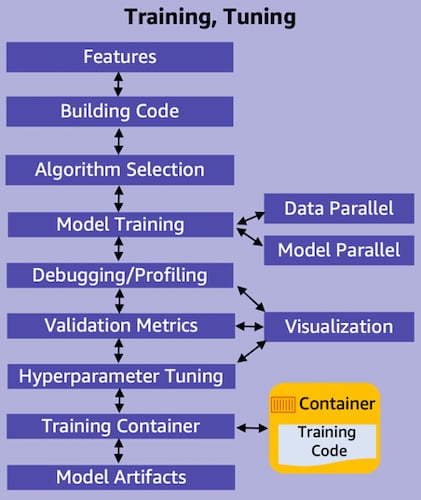
The main components of ML model training and tuning. Image used courtesy of AWS
Additionally, most embedded platforms lack the flexible tooling and debugging support available in server-class environments. Developers often alternate between simulation and physical hardware testing, introducing friction and increasing turnaround time. Managing platform-specific toolchains and runtime environments adds another layer of complexity.
Model compression and quantization—crucial for embedded feasibility—introduce additional tuning burdens. These transformations must be balanced carefully to preserve accuracy while reducing model size. Yet the optimal compression strategy varies with architecture, dataset, and hardware target, making automation difficult without specialized expertise.
A Scalable Future for Edge AI
With AutoML for Embedded, ADI and Antmicro deliver a toolchain that marries machine learning experimentation to deployment realities. AutoML for Embedded is now available via the Visual Studio Code Marketplace and GitHub.
Related Content