Facebook
 Google
 GitHub
 Linkedin
Cornell Rethinks Braille With Tiny Combustions and Soft Materials
A team of researchers has created a sealed, durable, and rapid tactile interface for on-screen Braille, offering a new approach to tactile accessibility.
In conventional refreshable Braille displays, each tactile dot is raised and lowered by a separate electromechanical actuator. While effective in controlled environments, these systems suffer from complexity, fragility, and poor scalability. The devices tend to be heavy, expensive, power-hungry, and particularly vulnerable to environmental contaminants such as dust or moisture.
Researchers at Cornell University and the Technion have proposed a radical alternative: using microscale combustion reactions to power tactile Braille actuators. These “tiny explosions”—or, more precisely, controlled ignition of small amounts of fuel and oxidizer—produce localized pressure bursts that drive soft silicone membranes outward. The resulting domes protrude from the surface, forming raised Braille dots with remarkable speed and force.
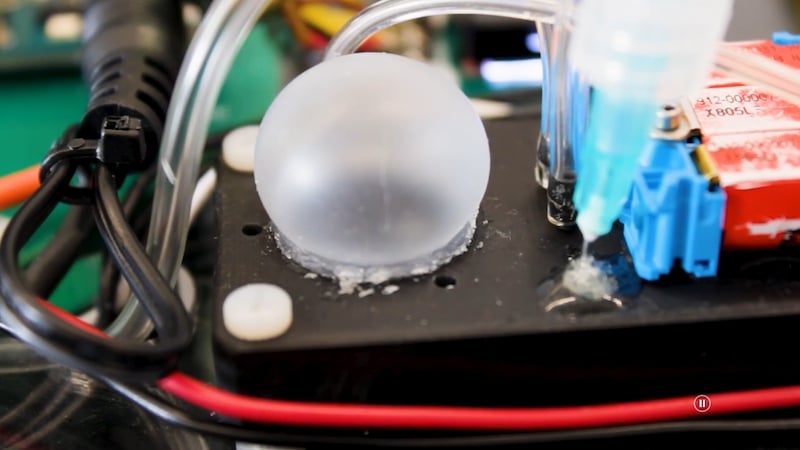
A dot, triggered by a mini combustion of oxygen and butane, pops up in 0.24 milliseconds and remains fixed in place by its domed shape until a vacuum sucks it down.
While the phrase “tiny explosions” may sound unstable, each actuator cavity is hermetically sealed and preloaded with fuel (butane and oxygen) in a micro-scale chamber. When a voltage is applied across an embedded wire mesh, it triggers a controlled ignition event. The thermal energy rapidly expands the gas inside the chamber, inverting the flexible silicone membrane into a stable dome.
A New Tactile Experience
According to the team’s research, the new combustion-driven actuators respond in just 0.24 milliseconds, achieving reliable actuation across hundreds of cycles without leakage or failure. Since the system is monolithic, it features no exposed moving parts and minimal mechanical interfaces. That makes it far less prone to failure from wear, grit, or environmental ingress.
More importantly, the actuated domes remain raised until intentionally retracted. That’s made possible through vacuum deactivation, which reverses the membrane back into its resting state. This bi-stability offers persistent tactile feedback without requiring continuous power, making it useful for mobile or off-grid applications where energy conservation is an important consideration.
The researchers demonstrated a nine-dot (3 x 3) prototype that selectively actuates individual dots in any combination. Unlike current single-line displays that require users to scroll line by line, this architecture lends itself to multi-line, high-resolution tactile output, opening the door to more efficient reading and even tactile graphics.
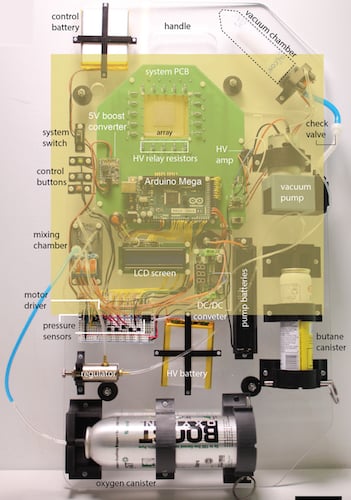
The untethered array system employs off-the-shelf and 3D-printed components on an acrylic sheet to clearly display the components.
While flame and soft materials might seem like an odd couple, the team’s work shows that the combination of controlled combustion and compliant mechanics can deliver powerful results. Importantly, the actuation chambers are completely sealed. There is no fire, heat, or exposure risk to users; the combustion simply provides the energy source for the pressure pulse, all contained within engineered elastomeric volumes.
Soft Actuation With a Bang
Compared to existing approaches, the Cornell team’s design has clear advantages: no exposed mechanical parts, fast response times, minimal wiring, and compatibility with soft, flexible substrates. This will naturally make the system highly attractive for tactile feedback in public kiosks, rugged outdoor terminals, or mobile accessibility devices where current electromechanical Braille displays fall short.
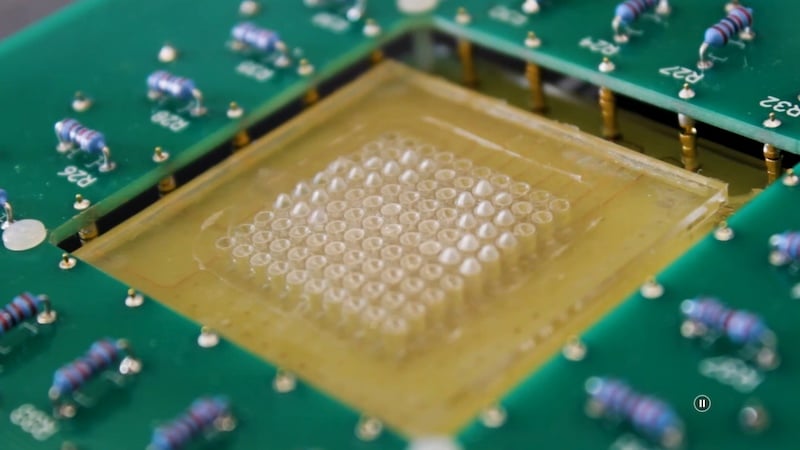
The technology may be used in teleoperation, automation, and virtual reality.
Still, challenges remain. Long-term cycling durability, fuel storage longevity, and integration with low-cost electronics need further investigation. Additionally, while the ignition energy is low, the use of combustible gases may face regulatory and perception hurdles in consumer devices. Future iterations may explore safer chemical alternatives or micro-scale solid fuel actuators to mitigate these concerns.
At its core, this work flips the conventional script on how to create tactile interfaces. Rather than scaling down industrial actuators to fit Braille, the team has designed a new kind of actuator around tactile feedback. For blind and visually impaired users, that could mean faster reading, better context, and more portable access to digital content.
All images used courtesy of Cornell University.