Facebook
 Google
 GitHub
 Linkedin
How Engineer Julius Edgar Lilienfeld Laid the Groundwork for Modern FETs
While the first working FET wouldn't appear until 1945, the idea appeared nearly 20 years prior in a patent held by Julius Edgar Lilienfeld.
Despite never having built a physical prototype, Julius Edgar Lilienfeld played a defining role in enabling future breakthroughs in semiconductor technology. His patent filed in 1925 is widely accepted as the world’s first theoretical concept of a field-effect transistor (FET), a crucial component of almost all electronic devices.
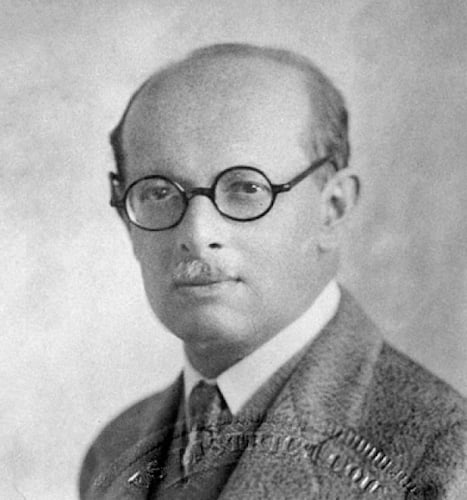
A photograph of Lilienfeld, aged 53. Image (modified) used courtesy of AIP Emilio Segre Visual Archives, Physics Today Collection via Computer History Museum
A Student of Quantum Theorist Max Planck
Born in 1882 in Lemberg, Austria-Hungary (modern-day Lviv, Ukraine), Lilienfeld pursued physics at Friedrich-Wilhelms-Universität (now Humboldt University) in Berlin, where he studied under Max Planck, a key figure in quantum theory. Lilienfeld earned his Ph.D. in 1905, during what was arguably one of the most transformative years in physics—when Albert Einstein published a series of papers that fundamentally changed the way people thought about space, time, mass, and energy.
After earning his Ph.D., Lilienfeld began working at the physics institute at Leipzig University as an untenured professor. His early work focused on the physics of electrical discharges in vacuums, and he quickly began publishing papers on the properties of glow discharges and a mercury low-pressure lamp with high output. Although this work wasn’t standard for the institute, Lilienfeld’s work was supported by renowned German physicist Otto Wiener.
From 1910 onwards, Lilienfeld conducted important early work on electrical discharges between metal electrodes in vacuums. He was instrumental in identifying field electron emission—a process where electrons escape from a solid surface under an electric field—as a distinct physical phenomenon, which he termed "auto-electronic emission.” Today, this is known as field electron emission. These observations later became fundamental principles for the development of theoretical models.
Patents That Paved the Way for FET Innovation
Between 1912 and 1931, Lilienfeld developed several patents. His first patent described an X-ray tube that produced X-rays from electrons emitted from a hot filament. This was refined in 1914 with a second patent filing for a Roentgen ray tube.
However, Lilienfeld is perhaps most known for his patent describing a device remarkably similar to the modern FET. The patent described a three-electrode structure using copper-sulfide semiconductor material. Specifically, it detailed:
- A thin film of "uni-directional conductivity" across two closely spaced metal electrodes
- A third electrode located between the two others used to apply an electrostatic force to control current flow
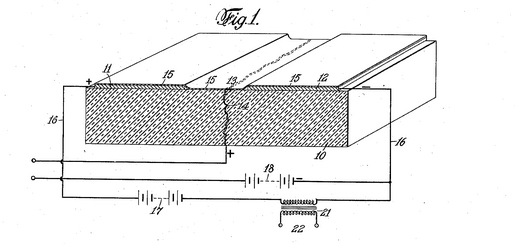
An illustration from Lilienfield’s 1930 patent application showing an apparatus for controlling electric currents. Image used courtesy of Espacenet
Lilienfeld suggested copper sulfide as a suitable compound for the semiconductor film and described several methods for depositing it, including vacuum sputtering. The device was theoretically designed to control the flow of electric current between two terminals of an electrically conducting solid by establishing a third potential between them.
Enabling the Transistor Revolution
While Lilienfeld couldn’t build a functional prototype due to material limitations, his idea underpins much of today’s transistor technology.
When Bell Labs scientists John Bardeen, Walter Brattain, and William Shockley developed the first practical transistors in the 1940s, they encountered challenges with patent claims because of Lilienfeld’s prior patents. Lilienfeld’s FET-like devices forced them to refine their designs and approaches. His patents were cited in their legal disputes and were an early blueprint for understanding transistor principles. Lilienfeld’s theory, for example, demonstrated how a solid-state device could amplify and control current without vacuum tubes. Though it took decades for materials and fabrication techniques to catch up, his concepts laid the groundwork for practical transistor development.
Though Lilienfeld’s work remained largely unknown during his life, his legacy has grown alongside innovations in transistor technology. Today, the Julius Edgar Lilienfeld Prize, established by the American Physical Society in 1988, honors physicists who make significant contributions and excel in communicating their science to the public.
Lilienfield died in August 1963 at the age of 81.