Facebook
 Google
 GitHub
 Linkedin
IBM & Ansys Detail Results From DARPA Thermonat Thermal Modeling Program
The research program aims to improve heat-prediction accuracy at the nanoscale while reducing simulation time for advanced semiconductor design.
Thermal management is becoming one of the most stubborn barriers to scaling as transistor geometries and interconnect dimensions continue to shrink. On January 20, IBM Research and Ansys published technical details from their collaboration under DARPA’s Thermonat program, describing a new approach to predicting thermal behavior at nanometer scales with near-atomistic accuracy and dramatically reduced compute cost.
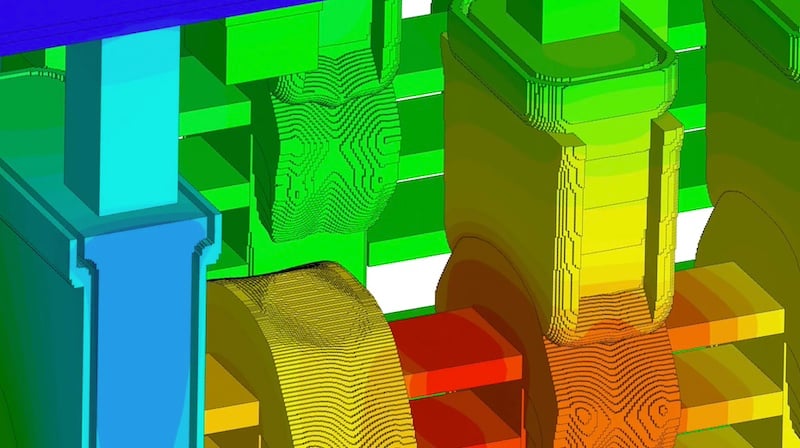
In under 18 months, Thermonat yielded foundational advances in modeling, predicting, and verifying heat flow in advanced semiconductor devices.
The work addresses a long-standing gap between physics-based thermal modeling and design-ready simulation. Classical thermal tools used in electronic design automation rely heavily on diffusive heat assumptions that hold water at larger scales but begin to break down as device dimensions approach phonon mean free paths (MFP).
At the same time, atomistic techniques such as molecular dynamics or first-principles calculations can capture the underlying physics, but are too slow to be applied across full devices or circuits. Thermonat set out to reconcile those extremes.
Nanoscale Thermal Modeling Bottlenecks
At advanced nodes, thermal behavior is shaped by interfaces and confined geometries rather than by raw material properties. FinFETs, GAA devices, dense back-end-of-line stacks, and early 3D integration schemes all introduce thermal resistances that are difficult to parameterize with traditional compact models, making it harder to predict hotspot formation and temperature gradients early in the design process.
While existing commercial solvers can scale to large designs, they often lack the fidelity needed to accurately capture nanoscale effects. Conversely, high-fidelity atomistic simulations provide insight into heat flow at the material and interface level, but can take days or weeks to complete even for small structures. That mismatch forces designers to choose between speed and accuracy, or to rely on conservative margins that limit performance.
The Thermonat program aims to eliminate that trade-off for good by bringing together industry, academia, and startups to explore multiscale approaches that bridge materials physics and circuit-scale modeling.
Thermonat and the IBM-Ansys Approach
Within Thermonat, IBM Research focused on creating a path from atom-level thermal behavior to models that could be integrated into existing simulation workflows. Working with Ansys, the team developed reduced-order thermal models derived from large sets of detailed finite-element simulations. These reduced models are designed to preserve a device's essential thermal response while discarding computational overhead that does not materially affect accuracy.

The team's thermal method achieved an accuracy of within 1°C while being 50,000x faster than state-of-the-art methods today.
According to Ansys, one demonstration involved generating several hundred finite-element simulations of a transistor structure over a short period, then using that data to train a reduced-order model. Once trained, the model could be applied to circuit-scale structures, including a ring oscillator containing roughly 1,000 transistors, while maintaining close correlation with measured temperature data. In more complex test cases, Ansys reported speedups of tens of thousands compared with full numerical simulations, while keeping temperature error within approximately 1°C.
The models were evaluated within established Ansys toolchains for power integrity and thermal analysis. These evaluations demonstrated their suitability for deployment in real-world applications where designers need to integrate thermal predictions into iterative design loops alongside electrical and timing analyses.
Multiple Parallel Approaches
DARPA has characterized Thermonat as a success in meeting its core objectives within a relatively short program timeline. Beyond IBM and Ansys, the effort produced multiple parallel approaches, including AI-accelerated multiscale pipelines developed by academic teams that later spun out into commercial startups. DARPA has also stated that IBM has already incorporated elements of its Thermonat-derived methods into internal process design kit workflows, allowing earlier evaluation of thermal tradeoffs during technology development.
Accurate, fast thermal modeling at the nanoscale enables designers to evaluate material choices, layout decisions, and power distributions earlier, when changes are still inexpensive. It also supports tighter coupling between device engineering and circuit design, which becomes increasingly important as thermal margins shrink.
While the Thermonat results do not eliminate the need for detailed numerical simulation or experimental validation, they point toward a future where atomistic insights can inform everyday design decisions without prohibitive computational costs.
All images used courtesy of IBM Research.