Facebook
 Google
 GitHub
 Linkedin
Infineon Reveals End-to-End Upgrades of Its Power and Sensing Portfolio
The company’s latest silicon, silicon carbide, and gallium nitride solutions offer a complete power conversion chain from the grid to the processor for AI data centers.
Infineon recently announced an extensive expansion of its power and sensing portfolio, introducing new digital controllers, point-of-load regulators, reference designs, and high-precision sensors specifically for AI data center architectures.
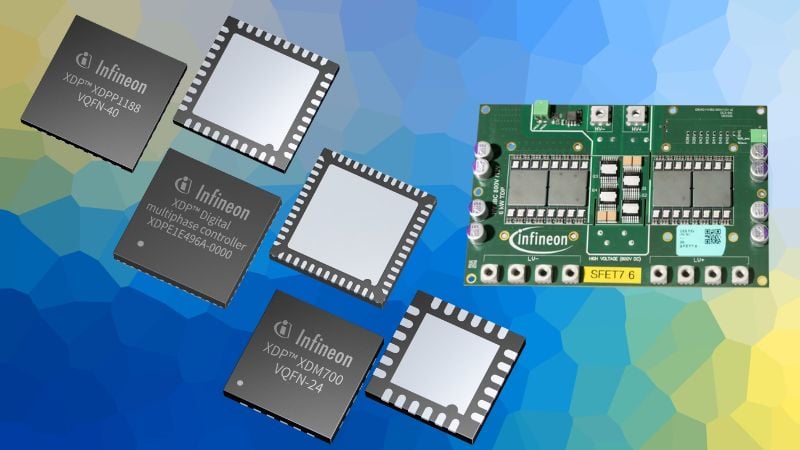
Infineon power and sensor upgrades.
With this slew of new components, Infineon hopes to provide engineers with a validated, end-to-end power delivery path that improves energy efficiency and reduces design cycles.
Infineon’s Expanded Power and Sensing Portfolio
The new products comprise the XDPE1E3G6A and XDPE1E496A digital multiphase PWM buck controllers, which Infineon believes engineers can use to scale compute performance for multi-processor platforms. These three- and four-loop controllers offer programmable phase-firing orders and support multiple protocols, including PMBus, AVSBus, and SVI3, to be compatible with many processor ecosystems.
To address dynamic AI loads, the controllers integrate active transient response and automatic phase shedding. Meanwhile, for non-core rails, the TDA49720/12/06 family of integrated point-of-load (PoL) regulators provides 6-, 12-, and 20-A options in packages as small as 3 mm x 3 mm. The PoLs are based on a proprietary valley-current-mode constant-on-time control scheme that is said to unlock fast transient response while supporting all-MLCC output capacitance designs.
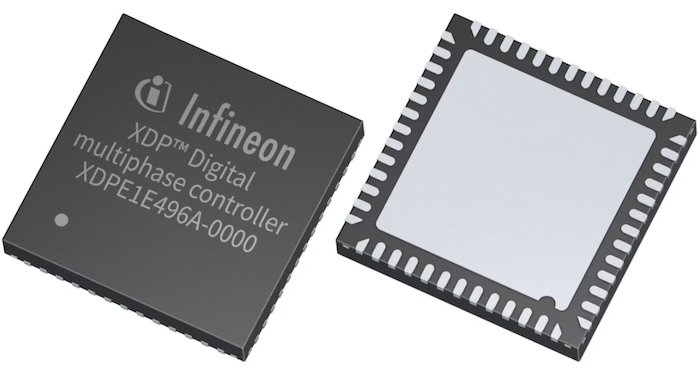
Three- and four-loop multiphase PWM buck controllers. Image used courtesy of Infineon
Engineers can further optimize high-voltage distribution using the XDPP1188-200C digital power controller, which supports conversions from 800 VDC or ±400 V down to 48 V, 24 V, or 12 V. This controller features an advanced feed-forward mechanism to improve stability during input transients and supports bidirectional configurations. Paired with these devices, two new CoolGaN-based reference designs deliver up to 98.2% peak efficiency for 800-VDC architectures. According to Infineon, the 800-V-to-12-V design achieves a power density exceeding 2,300 W/in3 using a matrix transformer to maintain an 8-mm height.
Finally, to ensure precise system monitoring, Infineon introduced the XDM700-1, a 12-bit digital current monitor that provides 0.4% voltage accuracy and 0.75% current accuracy via a 1-MHz PMBus 1.3 interface. Supplementing this module is the Xensiv TLE4978 magnetic current sensor, which uses a patented hybrid Hall-and-coil design to achieve a 9-MHz bandwidth and 38 mA-rms noise.
Hybrid Hall and Coil Current Sensing
For high-frequency power systems, engineers often struggle to use conventional current-sensing methods to balance high bandwidth, electrical isolation, and low noise. Hybrid current-sensing architectures solve this problem by combining two distinct physical sensing principles on a single CMOS die: Hall-effect elements and inductive coils.
Hall-effect elements detect static or slowly changing magnetic fields, providing accurate measurements from DC to several kilohertz. These elements generate a voltage proportional to the magnetic field strength when a current flows through the semiconductor material in the presence of a perpendicular magnetic field.
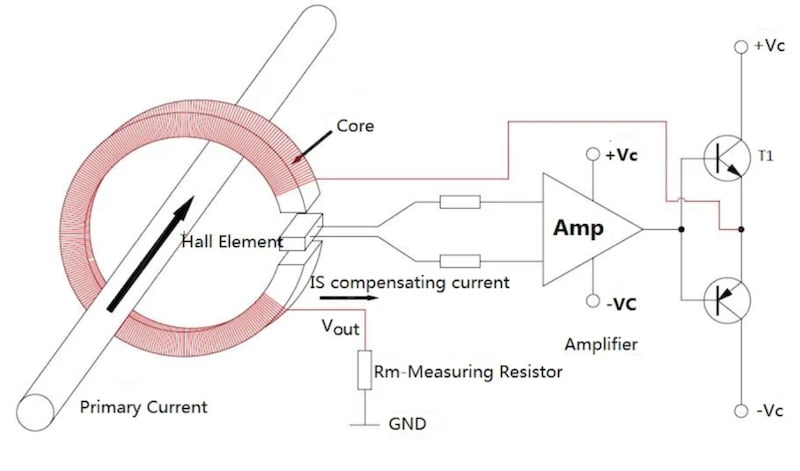
Hall-effect elements sensing diagram.
To capture the rapid transients in modern silicon carbide and gallium nitride power stages, the system uses monolithic air coils that operate similarly to Rogowski coils. Contrary to Hall elements, these coils are sensitive to the rate of change of the magnetic field. By integrating the induced voltage across these coils, the system can reconstruct the high-frequency components of the current waveform. A specialized signal processing chain then merges the low-frequency data from the Hall sensors with the high-frequency data from the coils.
This crossover technique expands the total sensing bandwidth into the megahertz range while keeping high DC accuracy. And, because this approach is coreless, it eliminates magnetic hysteresis and saturation effects, allowing the sensor to remain linear even during extreme overcurrent events.
Future Impact on Hyperscale Infrastructure
The XDPP1188-200C controller and XDM700-1 monitor are currently available as samples, with volume production for the monitor scheduled for April 2026. Xensiv TLE4978 sensor samples are now available.