Facebook
 Google
 GitHub
 Linkedin
ST Spins Out Op Amp Boasting High Accuracy, Speed, and Stability
The zero-drift TSZ901 brings microvolt-level offset and 10-MHz bandwidth to sensor interfaces and current measurement.
STMicroelectronics recently announced the TSZ901, a single-channel precision operational amplifier. Designed to deliver very low offset voltage, high stability over temperature, and relatively wide bandwidth, the device is well-suited for high-accuracy signal conditioning tasks in automotive and industrial sensor interfaces.
ST designed the TSZ901 for high-accuracy signal conditioning and automotive current measurement. Image (modified) used courtesy of STMicroelectronics
A Precision Op Amp Built for Speed and Stability
The TSZ901 (datasheet linked) features a chopper-stabilized amplifier architecture that ST engineered for DC precision across the entire operating range. The device features a maximum input offset voltage of 5 µV at 25°C, with a maximum deviation of 8 µV across the full temperature range (-40°C to 125°C). To ensure stability over time and across temperature shifts, the amplifier limits input offset voltage drift to 30 nV/°C. Such high precision lets design engineers create sensor interfaces that don’t require software calibration or hardware trimming during manufacturing.

The TSZ901's input offset voltage versus supply voltage. Image used courtesy of STMicroelectronics
Beyond DC precision, the amplifier offers substantial AC performance with a gain-bandwidth product of 10 MHz and a slew rate of 6 V/µs. Along with a low current consumption of 1.5 mA at 5 V, the device offers an impressive speed-to-power ratio for energy-constrained designs. The device also accepts a supply voltage range of 2.5 V to 5.5 V, features rail-to-rail capabilities on both input and output, and specifies a maximum input bias current of 300 pA over the full temperature range.
Finally, the TSZ901 addresses noise performance, with an input noise-voltage density of 9 nV/√Hz at 1 kHz and 10 kHz, and a low-frequency peak-to-peak noise of 0.16 µV between 0.1 Hz and 10 Hz. To support automotive requirements, the component is AEC-Q100 qualified and includes 4 kV of Human Body Model (HBM) ESD tolerance.
Understanding Zero-Drift Amplifiers
Zero-drift operational amplifiers use specialized internal architectures to continuously self-correct for DC errors, primarily input offset voltage and offset drift.
In standard amplifiers, the input offset voltage tends to drift due to temperature changes and component aging. When monitoring slow-moving, low-amplitude signals, this drift introduces measurement errors that are difficult to distinguish from the actual signal.
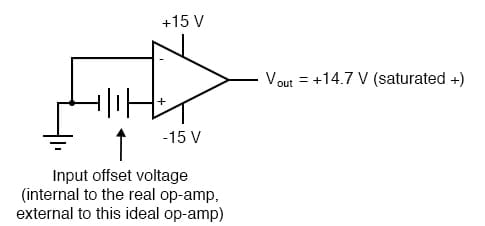
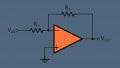
Op amp with input offset voltage.
Chopper stabilization is the primary mechanism for achieving zero-drift performance. The technique involves modulating the input signal to a higher frequency, amplifying it, and then demodulating it back to the baseband. During the modulation part of this process, the amplifier’s inherent DC offset and low-frequency noise (often called 1/f noise) remain at the baseband frequency. During demodulation, it is up-converted to the chopping frequency. Finally, a low-pass filter removes high-frequency artifacts, leaving the original signal amplified with virtually no offset or drift.
This continuous correction loop operates in the background, allowing the amplifier to maintain microvolt-level accuracy regardless of external temperature variations or time-dependent aging. With this technology, engineers no longer need to periodically recalibrate signals with complex compensation algorithms. It is particularly effective for resolving very small signal changes in environments with wide thermal swings, since the dominant error source is actively nullified by the chopping mechanism.
Outlook and Availability
STMicroelectronics offers the TSZ901 in standard industrial and AEC-Q100-qualified, automotive-grade SOT23-5 packages. According to the ST, the device is fully specified across its operating range and is production-ready now.