
 Facebook
 Google
 GitHub
 Linkedin
AC Electric Circuits
Characteristic Impedance
17 questions By Tony R. Kuphaldt
-
Question 10 of 17
What will happen if a cable is terminated by a resistor of incorrect value (not equal to the cable’s characteristic impedance)?
Reveal answerAny terminating resistance not equal to the cable’s characteristic resistance (either too small or too large) will result in reflected waves, albeit at lesser amplitude than if the cable were either unterminated or terminated by a direct short.
Notes:Answering this question is an exercise in qualitative thinking: compare the results of termination with the proper amount of resistance, versus termination with infinite or zero resistance. A terminating resistor of improper value will produce an effect somewhere between these extreme cases.
For instance, compare the cable impedance (as “seen” by the voltage source after a substantial amount of time) for a properly terminated cable, versus one that is either open-ended or shorted. What would a cable terminated by an improper-value resistor “look” like to the source after the propagation delay time has passed?
-
Question 11 of 17
A two-conductor cable of uniform construction will exhibit a uniform characteristic impedance (Z0) due to its intrinsic, distributed inductance and capacitance:
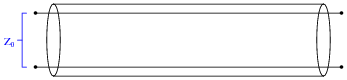
What would happen to the value of this characteristic impedance if we were to make the cable narrower, so that the conductors were closer together, all other dimensions remaining the same?

Reveal answerZ0 would decrease. I will leave it to you to explain why this happens.
Notes:Be sure to ask your students to explain why the characteristic impedance will change in the direction it does, based on the known changes to both capacitance and inductance throughout the cable. It should fairly simple for students to explain why capacitance will increase as the two conductors are brought closer together, but it may not be as apparent why the inductance will decrease. A good “Socratic” question to ask is about magnetic field strength, assuming one end of the cable were shorted, and a DC current source connected to the other end. Be sure to remind them to discuss the right-hand corkscrew rule for current and magnetic fields in their answer to this follow-up question!
-
Question 12 of 17
A two-conductor cable of uniform construction will exhibit a uniform characteristic impedance (Z0) due to its intrinsic, distributed inductance and capacitance:
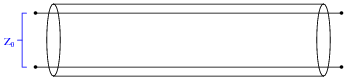
What would happen to the value of this characteristic impedance if we were to make the cable wider, so that the conductors were further apart, all other dimensions remaining the same?
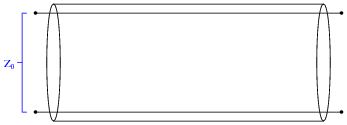
Reveal answerZ0 would increase. I will leave it to you to explain why this happens.
Notes:Be sure to ask your students to explain why the characteristic impedance will change in the direction it does, based on the known changes to both capacitance and inductance throughout the cable. It should fairly simple for students to explain why capacitance will increase as the two conductors are brought closer together, but it may not be as apparent why the inductance will decrease. A good “Socratic” question to ask is about magnetic field strength, assuming one end of the cable were shorted, and a DC current source connected to the other end. Be sure to remind them to discuss the right-hand corkscrew rule for current and magnetic fields in their answer to this follow-up question!


