
 Facebook
 Google
 GitHub
 Linkedin
AC Electric Circuits
Characteristic Impedance
17 questions By Tony R. Kuphaldt
-
Question 7 of 17
Suppose this 10-mile-long RG-58/U cable were “terminated” by a resistor with a resistance equal to the cable’s own characteristic impedance:
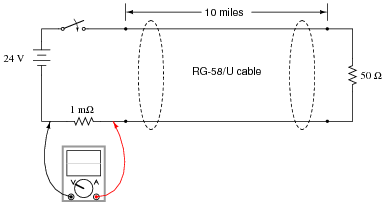
What sort of waveform or pulse would the oscilloscope register after switch closure?
Reveal answerThe oscilloscope would register a continuous current of 480 mA any time the switch is closed.
Notes:Ask your students to compare the behavior of this circuit with that of an unterminated RG-58/U cable. How does this circuit’s behavior differ? Why is that?
To phrase the question in a different way, what does the inclusion of a terminating resistor do to the apparent length of the cable? In other words, what length of RG-58/U cable would behave exactly the same as this circuit?
-
Question 8 of 17
When a pulse propagates down an “unterminated” cable and reaches an open-circuit, what does it do? Does it simply vanish, or does it go some place else?
Reveal answerA voltage pulse, upon reaching the open end of a cable, will be “reflected” back in the direction from which it came, its polarity being maintained while the current moves in the opposite direction.
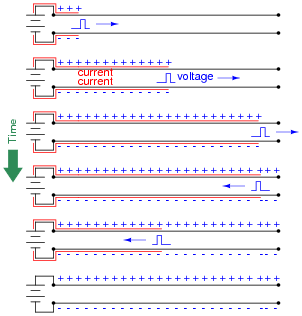
After the reflected pulse reaches the source, there will be maximum voltage at the source terminals and zero current in the cable.
Notes:To help answer this question, it is helpful to ask students how voltage and current relate to each other in an open-circuit condition (maximum voltage, zero current).
-
Question 9 of 17
When a pulse propagates down a cable terminated by a short-circuit, what does it do? Does it simply vanish, or does it go some place else?
Reveal answerA voltage pulse, upon reaching the shorted end of a cable, will be “reflected” back in the direction from which it came, its polarity being reversed while the current moves in the same direction.

After the reflected pulse reaches the source, there will be minimum voltage at the source terminals and maximum current in the cable.
Notes:To help answer this question, it is helpful to ask students how voltage and current relate to each other in a short-circuit condition (minimum voltage, maximum current).


