Facebook
 Google
 GitHub
 Linkedin
AC Electric Circuits
Impedance
19 questions By Tony R. Kuphaldt
-
Question 13 of 19
If a sinusoidal voltage is applied to an impedance with a phase angle of 90o, the resulting voltage and current waveforms will look like this:
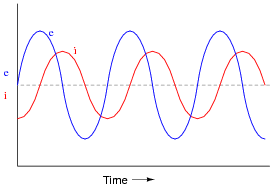
Given that power is the product of voltage and current (p = i e), plot the waveform for power in this circuit. Also, explain how the mnemonic phrase “ELI the ICE man” applies to these waveforms.
Reveal answer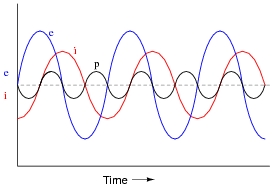
The mnemonic phrase, “ELI the ICE man” indicates that this phase shift is due to an inductance rather than a capacitance.
Notes:Ask your students to observe the waveform shown in the answer closely, and determine what sign the power values are. Note how the power waveform alternates between positive and negative values, just as the voltage and current waveforms do. Ask your students to explain what negative power could possibly mean.
Of what significance is this to us? What does this indicate about the nature of a load with an impedance phase angle of 90o?
The phrase, ËLI the ICE man” has been used be generations of technicians to remember the phase relationships between voltage and current for inductors and capacitors, respectively. One area of trouble I’ve noted with students, though, is being able to interpret which waveform is leading and which one is lagging, from a time-domain plot such as this.
-
Question 14 of 19
If a sinusoidal voltage is applied to an impedance with a phase angle of -90o, the resulting voltage and current waveforms will look like this:
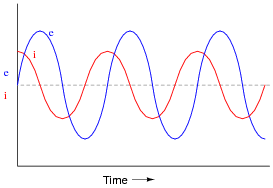
Given that power is the product of voltage and current (p = i e), plot the waveform for power in this circuit. Also, explain how the mnemonic phrase “ELI the ICE man” applies to these waveforms.
Reveal answer
The mnemonic phrase, “ELI the ICE man” indicates that this phase shift is due to a capacitance rather than an inductance.
Notes:Ask your students to observe the waveform shown in the answer closely, and determine what sign the power values are. Note how the power waveform alternates between positive and negative values, just as the voltage and current waveforms do. Ask your students to explain what negative power could possibly mean.
Of what significance is this to us? What does this indicate about the nature of a load with an impedance phase angle of -90o?
The phrase, ËLI the ICE man” has been used be generations of technicians to remember the phase relationships between voltage and current for inductors and capacitors, respectively. One area of trouble I’ve noted with students, though, is being able to interpret which waveform is leading and which one is lagging, from a time-domain plot such as this.
-
Question 15 of 19
Speakers used for audio reproduction systems (stereos, public address systems, etc.) act as power loads to the amplifiers which drive them. These devices convert electrical energy into sound energy, which then dissipates into the surrounding air. In this manner, a speaker acts much like a resistor: converting one form of energy (electrical) into another, and then dissipating that energy into the surrounding environment. Naturally, it makes sense to describe the nature of such loads in units of “ohms” (Ω), so that they may be mathematically analyzed in a manner similar to resistors.
Yet, despite the dissipative nature of audio speakers, their “ohms” rating is specified as an impedance rather than a resistance or a reactance. Explain why this is.
Reveal answerThe term “resistance” refers to the very specific phenomenon of electrical “friction,” converting electrical energy into thermal energy. The term “reactance” refers to electric current opposition resulting from a non-dissipative exchange of energy between the component and the rest of the circuit. The term “impedance” refers to any form of opposition to electric current, whether that opposition be dissipative or non-dissipative in nature.
While speakers are primarily dissipative devices, most of the energy dissipated by a speaker is not in the form of heat.
Notes:In a sense, resistance may be though of as a special (limiting) case of impedance, just as reactance is a special case of impedance. Discuss this concept with your students, especially with reference to devices such as speakers which are dissipative in nature (they dissipate energy) but yet not resistive in the strict sense of the term.
For this reason, the word “impedance” finds broad application in the world of electronics, and even in some sciences outside of electricity/electronics!