Facebook
 Google
 GitHub
 Linkedin
AC Electric Circuits
Impedance
19 questions By Tony R. Kuphaldt
-
Question 16 of 19
Engineers often write the capacitive and inductive reactance formulae in a different way from what you may have seen:
XL = ωL XC = 1 ωCThese equations should look familiar to you, from having seen similar equations containing a term for frequency (f). Given these equations’ forms, what is the mathematical definition of ω? In other words, what combination of variables and constants comprise “ω”, and what unit is it properly expressed in?
Reveal answerω = 2 πf, and it is expressed in units of radians per second.
Notes:Students who have taken trigonometry should recognize the radian as a unit for measuring angles. Discuss with your students why multiplying frequency (f, cycles per second) by the constant 2 π results in the unit changing to “radians per second”.
Engineers often refer to ω as the angular velocity of an AC system. Discuss why the term “velocity” is appropriate for ω.
-
Question 17 of 19
Engineers often calculate the impedance of pure capacitances and pure inductances in a way that directly provides results in rectangular (complex) form:
ZL = j ωL ZC = −j 1 ωCThe bold-faced type (Z instead of Z) signifies the calculated impedance as a complex rather than a scalar quantity. Given these equations’ forms, what is the mathematical definition of ω? In other words, what combination of variables and constants comprise “ω”, and what unit is it properly expressed in?
Also, determine what the equations would look like for calculating the impedance of these series networks:
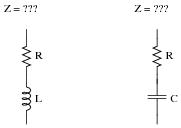
Reveal answerω = 2 πf is called the angular velocity of the circuit, and it is expressed in units of radians per second.
The impedance equations for the series LR and RC networks are as follows:
ZLR = R + j ωL ZRC = R - j 1 ωCNotes:Students who have taken trigonometry should recognize the radian as a unit for measuring angles. Discuss with your students why multiplying frequency (f, cycles per second) by the constant 2 π results in the unit changing to “radians per second”.
Engineers often refer to ω as the angular velocity of an AC system. Discuss why the term “velocity” is appropriate for ω.
-
Question 18 of 19
The mathematical inverse, or reciprocal, of resistance (R) is a quantity called conductance (G).
G = 1 RIs there an equivalent quantity for impedance (Z)? What is the reciprocal of impedance, and what unit of measurement is it expressed in? Hint: its symbol is Y.
Is there an equivalent quantity for reactance (X)? What is the reciprocal of reactance, and what unit of measurement is it expressed in? Hint: its symbol is B.
Reveal answerY = admittance, which is the reciprocal of impedance.
Y = 1 ZAdmittance is expressed in the unit of siemens.
B = susceptance, which is the reciprocal of reactance.
B = 1 XSusceptance is also expressed in the unit of siemens.
Notes:Ask your students where they obtained this information. Also ask them what the old (pre-siemens) unit of measurement was.
Where would such quantities be useful in AC circuit calculations? Ask your students where the quantity of conductance (G) is useful in DC circuit calculations.