Facebook
 Google
 GitHub
 Linkedin
AC Electric Circuits
Impedance
19 questions By Tony R. Kuphaldt
-
Question 4 of 19
In this AC circuit, the resistor offers 3 kΩ of resistance, and the capacitor offers 4 kΩ of reactance. Together, their series opposition to alternating current results in a current of 1 mA from the 5 volt source:

How many ohms of opposition does the series combination of resistor and capacitor offer? What name do we give to this quantity, and how do we symbolize it, being that it is composed of both resistance (R) and reactance (X)?
Reveal answerZtotal = 5 kΩ.
Notes:Students may experience difficulty arriving at the same quantity for impedance shown in the answer. If this is the case, help them problem-solve by suggesting they simplify the problem: short past one of the load components and calculate the new circuit current. Soon they will understand the relationship between total circuit opposition and total circuit current, and be able to apply this concept to the original problem.
Ask your students why the quantities of 3 kΩ and 4 kΩ do not add up to 7 kΩ like they would if they were both resistors. Does this scenario remind them of another mathematical problem where 3 4 = 5? Where have we seen this before, especially in the context of electric circuits?
Once your students make the cognitive connection to trigonometry, ask them the significance of these numbers’ addition. Is it enough that we say a component has an opposition to AC of 4 kΩ, or is there more to this quantity than a single, scalar value? What type of number would be suitable for representing such a quantity, and how might it be written?
-
Question 5 of 19
While studying DC circuit theory, you learned that resistance was an expression of a component’s opposition to electric current. Then, when studying AC circuit theory, you learned that reactance was another type of opposition to current. Now, a third term is introduced: impedance. Like resistance and reactance, impedance is also a form of opposition to electric current.
Explain the difference between these three quantities (resistance, reactance, and impedance) using your own words.
Reveal answerThe fundamental distinction between these terms is one of abstraction: impedance is the most general term, encompassing both resistance and reactance. Here is an explanation given in terms of logical sets (using a Venn diagram), along with an analogy from animal taxonomy:
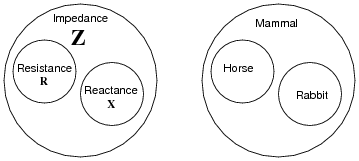
Resistance is a type of impedance, and so is reactance. The difference between the two has to do with energy exchange.
Notes:The given answer is far from complete. I’ve shown the semantic relationship between the terms resistance, reactance, and impedance, but I have only hinted at the conceptual distinctions between them. Be sure to discuss with your students what the fundamental difference is between resistance and reactance, in terms of electrical energy exchange.
-
Question 6 of 19
It is often necessary to represent AC circuit quantities as complex numbers rather than as scalar numbers, because both magnitude and phase angle are necessary to consider in certain calculations.
When representing AC voltages and currents in polar form, the angle given refers to the phase shift between the given voltage or current, and a “reference” voltage or current at the same frequency somewhere else in the circuit. So, a voltage of 3.5 V ∠−45o means a voltage of 3.5 volts magnitude, phase-shifted 45 degrees behind (lagging) the reference voltage (or current), which is defined to be at an angle of 0 degrees.
But what about impedance (Z)? Does impedance have a phase angle, too, or is it a simple scalar number like resistance or reactance?
Calculate the amount of current that would go through a 100 mH inductor with 36 volts RMS applied to it at a frequency of 400 Hz. Then, based on Ohm’s Law for AC circuits and what you know of the phase relationship between voltage and current for an inductor, calculate the impedance of this inductor in polar form. Does a definite angle emerge from this calculation for the inductor’s impedance? Explain why or why not.
Reveal answerZL = 251.33 Ω ∠ 90o
Notes:This is a challenging question, because it asks the student to defend the application of phase angles to a type of quantity that does not really possess a wave-shape like AC voltages and currents do. Conceptually, this is difficult to grasp. However, the answer is quite clear through the Ohm’s Law calculation (Z = E/I).
Although it is natural to assign a phase angle of 0o to the 36 volt supply, making it the reference waveform, this is not actually necessary. Work through this calculation with your students, assuming different angles for the voltage in each instance. You should find that the impedance computes to be the same exact quantity every time.