
 Facebook
 Google
 GitHub
 Linkedin
Discrete Semiconductor Devices and Circuits
Insulated Gate Field-Effect Transistors
39 questions By Tony R. Kuphaldt
-
Question 22 of 39
Anti-static wrist straps are commonly worn by technicians when performing work on circuits containing MOSFETs. Explain how these straps are used, and how you would test one to ensure it is functioning properly.
Reveal answer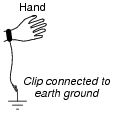
A simple ohmmeter test should reveal mega-ohm levels of resistance between the strap’s skin contact point and the metal grounding clip.
Follow-up question: why is there resistance intentionally placed between the wrist strap and the grounding clip? What would be wrong with simply having a 0 Ω connection between the strap and earth ground (i.e. an uninterrupted length of wire)?
Notes:A good question to ask your students is why anti-static protection is important when working with MOSFET devices. You should never assume this is obvious, unless the subject was covered in a question immediately previous to this one!
Your students should have an anti-static wrist strap as part of their regular tool collection. When discussing this question, it would be good to have students use their ohmmeters to verify the operation of their wrist straps.
-
Question 23 of 39
Complete the circuit, showing how the pushbutton switch could be connected to the gate of the MOSFET in order to exert control over the load:

Reveal answerThis solution, while workable, is not the most practical. Improve on this design!
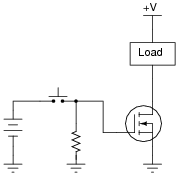
Follow-up question: would you say this transistor sources current to the load, or sinks current from the load? Explain your answer.
Notes:Discuss with your students why the circuit shown in the answer would not necessarily be practical, and work together to develop a better design.
-
Question 24 of 39
Determine whether the load is energized or de-energized with the switch in the position shown. Also, identify whether the transistor is a depletion type or an enhancement type:

Reveal answerThe load will be de-energized as a result of this depletion-type transistor being in the “off” state.
Notes:Ask your students to explain how they figured out the state of the transistor in this circuit, and also what function the double-pole, double-throw (DPDT) switch performs. Incidentally, this DPDT switch wiring configuration is quite common in electrical and electronic circuits!


