Facebook
 Google
 GitHub
 Linkedin
Discrete Semiconductor Devices and Circuits
Insulated Gate Field-Effect Transistors
39 questions By Tony R. Kuphaldt
-
Question 25 of 39
Determine whether the load is energized or de-energized with the switch in the position shown. Also, identify whether the transistor is a depletion type or an enhancement type:

Reveal answerThe load will be energized as a result of this enhancement-type transistor being in the “on” state.
Notes:Ask your students to explain how they figured out the state of the transistor in this circuit, and also what function the double-pole, double-throw (DPDT) switch performs. Incidentally, this DPDT switch wiring configuration is quite common in electrical and electronic circuits!
-
Question 26 of 39
Determine whether the load is energized or de-energized with the switch in the position shown. Also, identify whether the transistor is a depletion type or an enhancement type:

Reveal answerThe load will be energized as a result of this depletion-type transistor being in the “on” state.
Notes:Ask your students to explain how they figured out the state of the transistor in this circuit, and also what function the double-pole, double-throw (DPDT) switch performs. Incidentally, this DPDT switch wiring configuration is quite common in electrical and electronic circuits!
-
Question 27 of 39
Determine whether the load is energized or de-energized with the switch in the position shown. Also, identify whether the transistor is a depletion type or an enhancement type:
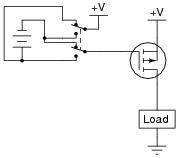
Reveal answerThe load will be energized as a result of this enhancement-type transistor being in the “on” state.
Notes:Ask your students to explain how they figured out the state of the transistor in this circuit, and also what function the double-pole, double-throw (DPDT) switch performs. Incidentally, this DPDT switch wiring configuration is quite common in electrical and electronic circuits!