Facebook
 Google
 GitHub
 Linkedin
Discrete Semiconductor Devices and Circuits
Insulated Gate Field-Effect Transistors
39 questions By Tony R. Kuphaldt
-
Question 31 of 39
Explain what will happen in this circuit when each pushbutton switch is individually actuated:

Can you think of any practical applications for a circuit like this?
Reveal answerThis circuit is commonly known as a bistable latch, since it is able to “latch” into two different stable states.
If you experience difficulty analyzing this circuit’s operation, imagine that one of the transistors is in the “on” state and the other is in the “off” state immediately after power-up. Then ask yourself what will happen when each pushbutton is actuated.
Notes:Bistable latch, or multivibrator, circuits are quite useful and quite simple to implement with MOSFETs as this example demonstrates. Discuss some practical applications with your students, especially if they have not discovered a few applications of their own.
-
Question 32 of 39
This circuit uses a combination of capacitance and resistance to produce a time delay when the pushbutton switch is released, causing the lamp to remain on for a short while after the switch opens:
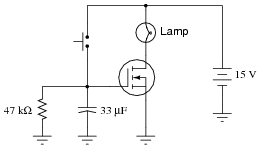
Calculate how long the lamp will remain on after the switch opens, assuming the MOSFET has a gate threshold (turn-on) voltage of VGS(th) = 4 volts.
Reveal answertdelay = 2.05 seconds
Notes:In order to solve this problem, students must apply their knowledge of capacitive discharge circuits to find the correct equation for time. Ask them how they set up the solution, and how they knew what equation(s) to use.
-
Question 33 of 39
Predict how this circuit will be affected as a result of the following faults. Consider each fault independently (i.e. one at a time, no multiple faults):
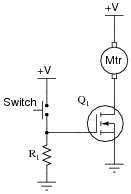
- Transistor Q1 fails open (drain-to-source):
- Transistor Q1 fails shorted (drain-to-source):
- Resistor R1 fails open:
For each of these conditions, explain why the resulting effects will occur.
Reveal answer- Transistor Q1 fails open (drain-to-source): Motor refuses to run.
- Transistor Q1 fails shorted (drain-to-source): Motor runs all the time and will not turn off.
- Resistor R1 fails open: Motor runs when switch is pressed, takes a long time to turn off when switch is released.
Notes:The purpose of this question is to approach the domain of circuit troubleshooting from a perspective of knowing what the fault is, rather than only knowing what the symptoms are. Although this is not necessarily a realistic perspective, it helps students build the foundational knowledge necessary to diagnose a faulted circuit from empirical data. Questions such as this should be followed (eventually) by other questions asking students to identify likely faults based on measurements.