Facebook
 Google
 GitHub
 Linkedin
Digital Circuits
Latch Circuits
26 questions By Tony R. Kuphaldt
-
Question 1 of 26
What do you think this logic buffer gate will do, with the output signal “feeding back” to the input?

What do you think this buffer will do when each input switch is separately pressed?

Why does the second buffer circuit need a resistor in the feedback loop?
Reveal answerThe first circuit will “latch” in whatever logic state it powers up in. The second circuit will be “set” or “reset” according to which pushbutton switch is actuated, then latch in that state when neither switch is being pressed. The resistor prevents the gate from “seeing” a short circuit at its output when a pushbutton switch is actuated to change states.
Challenge question: how would you determine an appropriate size for the resistor? Don’t just guess - base your answer on specific performance parameters of the gate!
Notes:This is a very crude sort of latch circuit, but it is easier to understand than the typical cross-connected NOR or NAND gate latches commonly introduced to circuits. One of the major ideas in this question is the concept of positive feedback, and how this form of feedback leads to hysteric behavior. If appropriate, refer your students to SCRs and other thyristors as previous examples of hysteric devices based on positive feedback.
-
Question 2 of 26
When studying latch circuits, you will come across many references to set and reset logic states. Give a simple definition for each of these terms in the context of latch and flip-flop circuits.
Reveal answerA latch is considered set when its output (Q) is high, and reset when its output (Q) is low.
Notes:Having a consistent definition for “set” and “reset” is important, especially as students study multiple latch circuit topologies and active-low inputs!
-
Question 3 of 26
The circuit shown here is called an S-R latch:

Complete the truth table for this latch circuit:
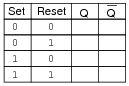
Reveal answer
Follow-up question: The final state of this truth table (where the “Set” and “Reset” inputs are both high) is usually referred to as invalid. Explain why.
Notes:The “latch” state is the most interesting in this circuit. Discuss what this means with your students, especially since it is impossible to describe the “latch” state in terms of fixed 1’s and 0’s.