Facebook
 Google
 GitHub
 Linkedin
Analog Integrated Circuits
Logarithms for Analog Circuits
16 questions By Tony R. Kuphaldt
-
Question 13 of 16
Examine this progression of mathematical statements:
√ 1000= 101.5 log √ 1000= log( 101.5 ) log( 10001/2 ) = log( 101.5 ) 1 2(log1000) = log( 101.5 ) 1 2(log103) = log( 101.5 ) 3 2(log10) = log( 101.5 ) 3 2(1) = log( 101.5 ) 3 2= log( 101.5 ) 3 2= 1.5 What began as a fractional exponent problem ended up as a simple fraction, through the application of logarithms. What does this tell you about the utility of logarithms as an arithmetic tool?
Reveal answerThat logarithms can reduce the complexity of an equation from fractional exponentiation, down to simple fractions, indicates its usefulness as a tool to simplify arithmetic problems. Specifically, the logarithm of a root of a number is equal to the logarithm of that number divided by the root index.
Notes:In mathematics, any procedure that reduces a complex type of problem into a simpler type of problem is called a transform function, and logarithms are one of the simplest types of transform functions in existence.
-
Question 14 of 16
Suppose you owned a scientific calculator with two broken buttons: the power (yx) and root (x
√{y}). Demonstrate how you could solve this simple root problem using only logarithms, division, and antilogarithms (powers):
3√8= ??? The answer to this problem was easy enough for you to figure out without a calculator at all, so here are some more practice problems for you to try:
- 4 √{13} =
- 5 √{209} =
- 2.5 √{9935} =
- 9.2 √{0.15} =
Reveal answerHere I will show you the steps to using logarithms to solve the first multiplication problem:
3√8= ??? 3√8= 10( 1/3 log8 ) 3√8= 10( 1/3 (0.9031) ) 3√8= 100.3010 3√8= 2 Since the others are easy enough for you to check (with your non-broken calculator!), I’ll leave their solutions in your capable hands.
Notes:Incidentally, there is nothing special about the common logarithm to warrant its exclusive use in this problem. We could have just as easily applied the natural logarithm function with the same (final) result:
3√8= ??? 3√8= e( 1/3 ln8 ) 3√8= e( 1/3 (2.0794) ) 3√8= e0.6931 3√8= 2 -
Question 15 of 16
You may be wondering why anyone would bother using logarithms to solve arithmetic problems for which we have perfectly good and effective digital electronic calculator functions at our disposal. For example, why would anyone do this:
10log7 + log5 . . . when they could just do the following on the same calculator?
7 ×5 The quick answer to this very good question is, “when it is more difficult to directly multiply two numbers.” The trouble is, most people have a difficult time imagining when it would ever be easier to take two logarithms, add them together, and raise ten to that power than it would be to simply multiply the original two numbers together.
The answer to that mystery is found in operational amplifier circuitry. As it turns out, it is much easier to build single opamp circuits that add, subtract, exponentiate, or take logarithms than it is to build one that directly multiplies or divides two quantities (analog voltages) together.
We may think of these opamp functions as “blocks” which may be interconnected to perform composite arithmetic functions:
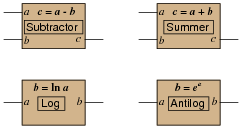
Using this model of specific math-function “blocks,” show how the following set of analog math function blocks may be connected together to multiply two analog voltages together:
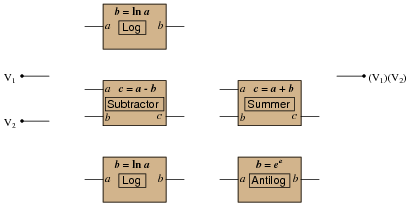
Reveal answer
Notes:The purpose of this question is simple: to provide a practical application for logarithms as computational aids in an age of cheap, ubiquitous, digital computing devices.