Facebook
 Google
 GitHub
 Linkedin
AC Electric Circuits
Mutual Inductance
12 questions By Tony R. Kuphaldt
-
Question 7 of 12
Suppose two wire coils are wound around a common iron core, the “primary” coil with 100 turns of wire and the “secondary” coil with 300 turns of wire:
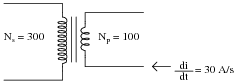
If the inductance of the primary coil is 2 H, what is the inductance of the secondary coil, assuming that it “sees” the exact same magnetic circuit as the first coil (same permeability, same cross-sectional area, same length)?
If an electric current changing at a rate of 30 amps per second passes through the primary coil, how much voltage will be induced in each coil?
If only half the lines of magnetic flux from the primary coil “coupled” with the secondary coil, how much voltage would be induced in the secondary coil, given a primary current rate-of-change of 30 amps per second?
Reveal answerLs = 18 H
ep = 60 volts
es = 180 volts
If only half the lines of flux coupled the two coils (k = 0.5), then es = 90 volts.
Follow-up question: what do you notice about the ratio of primary and secondary inductances compared with primary and secondary winding turns? Can you generalize this in the form of an equation?
Notes:The key to this question is determining the ratio of inductances, based on the ratio of turns in the windings. As the answer reveals, it is a nonlinear proportionality. The sentence where I specify the “same permeability, same cross-sectional area, same length” is a hint to students for what equation they need to find in order to identify the relationship between wire turns and inductance.
-
Question 8 of 12
Mutual inductance is the term given to the phenomenon where a change in current through one inductor causes a voltage to be induced in another. When two inductors (L1 and L2) are magnetically “coupled,” the mutual inductance (M) relates their voltages and currents as such:
e1 = M di2 dtVoltage induced in coil 1 by change of current in coil 2 e2 = M di1 dtVoltage induced in coil 2 by change of current in coil 1 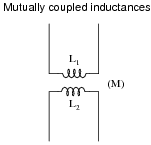
When the magnetic coupling between the two inductors is perfect (k = 1), how does M relate to L1 and L2? In other words, write an equation defining M in terms of L1 and L2, given perfect coupling.
Hint:
e1 = L2 N1 N2di2 dte2 = L1 N2 N1di1 dtL1 L2= ( N1 N2) 2 Reveal answerM = √{L1 L2}
Challenge question: is mutual inductance expressed in the same unit of measurement that self-inductance is? Why or why not?
Notes:The solution to this question involves quite a bit of algebraic manipulation and substitution. Of course, it may also be found in many basic electronics textbooks, but the point of this question is for students to see how it may be derived from the equations they already know.
-
Question 9 of 12
The coefficient of magnetic coupling between two coils affects the amount of mutual inductance between those two coils. This fact should be obvious, as coils not sharing any magnetic flux (k = 0) cannot have any mutual inductance between them.
Write an equation defining M in terms of L1 and L2, when k is something less than 1.
Reveal answerM = k √{L1 L2}
Notes:Ask your students how they obtained their answer. Of course this equation may be found in many basic electronics textbooks, but the point of this question is for students to see how it may be derived from the equations they already know.