Facebook
 Google
 GitHub
 Linkedin
Mathematics for Electronics
Phasor Mathematics
13 questions By Tony R. Kuphaldt
-
Question 7 of 13
Compare these three mathematical series, one for ex, one for cosx, and one for sinx:
$$e^x = 1+x+ \frac{x^2}{2!} + \frac{x^3}{3!} + \frac{x^4}{4!} + \frac{x^5}{5!} + + \frac{x^6}{6!} + + \frac{x^7}{7!} ...$$
$$cos \ x = 1 - \frac{x^2}{2!} + \frac{x^4}{4!} - \frac{x^6}{6!} + ...$$
$$sin \ x = x - \frac{x^3}{3!} + \frac{x^5}{5!} - \frac{x^7}{7!} + ...$$
Note similarities in the terms of these three series. Aside from signs, it would appear the cosine series contains all the even-powered terms of ex and the sine series contains all the odd-powered terms of ex. Leonhard Euler, the Swiss mathematician who lived from 1707 to 1783, found a connection between these three series which became known as Euler’s relation.
You too can find this same connection if you substitute jx for x in the first (ex) series, and then multiply all terms in the sine series by j. Leave the cosine series unaltered. Remember that j = √{−1} and that j2 = −1, j3 = −j, j4 = 1, j5 = j, etc.
Reveal answerFirst, I’ll perform the substitutions and multiplications for you:
ejx = 1 + jx (jx)2 2!+ (jx)3 3!+ (jx)4 4!+ (jx)5 5!+ (jx)6 6!+ (jx)7 7!+ … cos x = 1 − x2 2!+ x4 4!− x6 6!+ … j sinx = jx − j x3 3!+ j x5 5!− j x7 7!+ … If you properly calculate all the powers of j, you will find this relationship between these three series:
ejx = cos x + j sinx Notes:For those students who need a little more help, here is the ejx series before and after simplification:
ejx = 1 + jx (jx)2 2!+ (jx)3 3!+ (jx)4 4!+ (jx)5 5!+ (jx)6 6!+ (jx)7 7!+ … ejx = 1+ jx − x2 2!− j x3 3!+ x4 4!+ j x5 5!− x6 6!− j x7 7!+ … Now, the composition of the ejx series as being the sum of the cosx series and the j sinx series should be more evident.
-
Question 8 of 13
A fascinating mathematical identity discovered by Leonhard Euler (1707-1783), regarded by some as the most beautiful equation in all of mathematics, relates five of mathematics’ fundamental constants together:
ei π + 1 = 0 Use Euler’s relation to translate this identity into trigonometric terms, where the truth of this identity will become more evident.
Reveal answercosπ + j sinπ + 1 = 0 Notes:The beauty of this identity cannot be denied, relating five fundamental constants of mathematics (e, i, π, 1, and 0) together in one simple equation.
Note: here I break stylistic convention by using the more traditionally mathematical i instead of the traditionally electrical j to represent √{−1}. For those who just can’t stand to see i represent anything other than instantaneous current, here you go:
ej π + 1 = 0 Are you happy now?
-
Question 9 of 13
If you have studied complex numbers, you know that the same complex quantity may be written in two different forms: rectangular and polar. Take for example the complex quantity [(√3)/2] j1/2. The following illustration shows this point located on the complex plane, along with its rectangular dimensions:
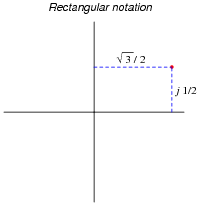
Next, we see the same point, on the same complex plane, along with its polar coordinates:
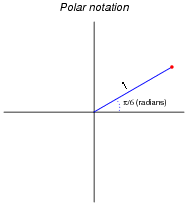
Written out, we might express the equivalence of these two notations as such:
$$\frac{\sqrt{3}}{2} + j \frac{1}{2} = 1 \angle \frac{\pi}{6}$$
Expressed in a more general form, the equivalence between rectangular and polar notations would look like this:
a + jb = c ∠Θ However, a problem with the “angle” symbol (∠) is that we have no standardized way to deal with it mathematically. We would have to invent special rules to describe how to add, subtract, multiply, divide, differentiate, integrate, or otherwise manipulate complex quantities expressed using this symbol. A more profitable alternative to using the “angle” symbol is shown here:
a + jb = c ejΘ Explain why this equivalence is mathematically sound.
Reveal answerThe equivalence shown is based on Euler’s relation, which is left to you as an exercise to prove.
Notes:This question should probably be preceded by #04058, which asks students to explore the relationship between the infinite series for ex, cosx, and sinx. In any case, your students will need to know Euler’s relation:
ejx = cos x + j sinx