
 Facebook
 Google
 GitHub
 Linkedin
Basic Electricity
Physical Effects of Electricity
11 questions By Tony R. Kuphaldt
-
Question 7 of 11
What difference will it make if the battery in this circuit is reversed in direction?

Reveal answerThe choice of battery “polarity” in a simple light bulb circuit makes no difference at all. In either case, the light bulb will energize when the switch is closed.
Notes:It should be noted that not all electrical loads are “non-polarized” like an incandescent light bulb. Some electrical components, such as light-emitting diodes, are polarity sensitive, and will function only if current goes through them in the proper direction.
-
Question 8 of 11
What physical effects of electricity are manifest in a lightning strike?
Reveal answerHeat, light, sound, magnetism (compass needles deflecting), radio (“static” heard on AM radios), and chemical reactions (fixation of nitrogen, and the production of ozone).
Notes:Lightning is a universally recognized phenomenon, and one that inspires no small amount of awe. In other words, it is a perfect discussion topic in a science-oriented class! There is much to be learned about lightning from a variety of sources, and it serves as a vivid illustration of electricity’s varied effects.
Having discussed several effects of electricity manifest in lightning strikes, it is an interesting class exercise to discuss possible applications of these effects. What can we do with such phenomenon? Knowing that electricity has the ability to produce heat, light, sound, magnetism, electromagnetic waves, and chemical reactions, what interesting and useful things may we employ electricity for?
-
Question 9 of 11
If the terminals of a DC voltage source are connected to individual wires, dipped in a container full of water, an interesting effect takes place on the submerged surfaces of the wires. What is this phenomenon, and what is it called?
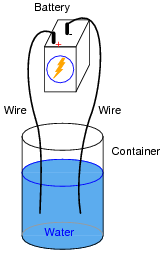
Reveal answerI’ll let you discover the actual phenomenon on your own (be careful to use no more than 12 volts when performing an experiment like this, for safety!), but its name is electrolysis.
Notes:Electrochemical effects are very commonly used in industry to form chemical substances. Ironically, the battery itself shown in the illustration, is another example of electrochemistry in action, just hidden from sight!


