
 Facebook
 Google
 GitHub
 Linkedin
Basic Electricity
Resistors
11 questions By Tony R. Kuphaldt
-
Question 7 of 11
What does the last color band represent on a color-coded resistor?
Reveal answerThere is more than one answer to this question! On some resistors, the last band represents the tolerance (also known as precision) for that resistor, expressed as a percentage. On other resistors, the last band represents a reliability rating for that resistor.
Notes:This question is worded simply and directly enough that students might think there is only one right answer. However, upon doing some research they should find that there is more involved than one simple answer can encompass! Discuss with your students the different color code types, and what applications one might find resistors with “reliability” color codes in.
Regarding precision, nothing in life is perfectly accurate. However, the absence of perfect accuracy does not necessarily imply total uncertainty. In science, especially, it is important that all data be qualified by a statement of precision (or tolerance). Your students may be familiar with “margins of error” stated for public opinion polls. With resistors, this “margin of error” (expression of uncertainty) is explicitly given in the form of a separate color band.
-
Question 8 of 11
Determine the nominal resistance values of these resistors, given their band colors, and also express the allowable tolerance in ohms.
For example, a 25 kΩ resistor with a 10% tolerance rating would have an allowable tolerance of /- 2.5 kΩ.
- • Red, Org, Blu, Gld =
- • Brn, Blk, Grn, Sil =
- • Blu, Blk, Brn, Gld =
- • Yel, Vio, Red, Sil =
- • Grn, Brn, Yel =
- • Wht, Blu, Blk, Sil =
- • Gry, Grn, Org, Gld =
- • Org, Org, Gld =
- • Vio, Red, Sil, Gld =
- • Brn, Red, Blk, Sil =
Reveal answer- • Red, Org, Blu, Gld = 23 MΩ, /- 1.15 MΩ
- • Brn, Blk, Grn, Sil = 1 MΩ, /- 100 kΩ
- • Blu, Blk, Brn, Gld = 600 Ω, /- 30 Ω
- • Yel, Vio, Red, Sil = 4.7 kΩ, /- 470 Ω
- • Grn, Brn, Yel = 510 kΩ, /- 102 kΩ
- • Wht, Blu, Blk, Sil = 96 Ω, /- 9.6 Ω
- • Gry, Grn, Org, Gld = 85 kΩ, /- 4.25 kΩ
- • Org, Org, Gld = 3.3 Ω, /- 0.66 Ω
- • Vio, Red, Sil, Gld = 0.72 Ω, /- 0.036 Ω
- • Brn, Red, Blk, Sil = 12 Ω, /- 1.2 Ω
Notes:This question serves as a great review for the mathematical concepts of scientific notation and percentages. Challenge your students to perform all the math without using a calculator, and without writing anything!
-
Question 9 of 11
Observe the following “5-band” precision resistors, their color codes, and corresponding resistance values (note that the last color band is omitted, since it deals with precision and not nominal value):
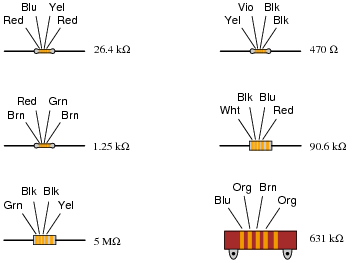
What patterns do you notice between the color codes (given as three-letter abbreviations, so as to avoid interpretational errors resulting from variations in print quality) and the resistance values of each resistor? Why do precision resistors use a “5-band” color code instead of a “4-band” color code?
Reveal answerThe first three color “bands” for precision five-band resistors denote three digits and a “multiplier” value, respectively. A five-band color code is necessary to express resistance with a greater number of significant digits than a four-band code.
Notes:The normal way to teach students the resistor color code is to show them the code first, then show them some resistors. Here, the sequence is reversed: show the students some resistors, and have them figure out the code. An important cognitive skill is the ability to detect and apply patterns in sets of data. Exercises such as this help build that skill.
It should be noted that there is a 5-band color code for non-precision resistors as well, with the first four bands serving the same purpose as in a 4-band code, the extra band indicating resistor reliability. This scheme was developed for military purposes and is seldom seen in civilian circuitry.






Awesome! job!!!
Informative 😊
https://forum.allaboutcircuits.com/threads/resistor-worksheet-question-8-insufficient-resources.199603/post-1894332
Hi, A query has been raised on the main Forum by a poster, regarding this Article. [ above thread ]. Request clarification.