
 Facebook
 Google
 GitHub
 Linkedin
Network Analysis Techniques
Superposition Theorem
17 questions By Tony R. Kuphaldt
-
Question 16 of 17
Sketch the approximate waveform of this circuit’s output signal (Vout) on the screen of the oscilloscope:
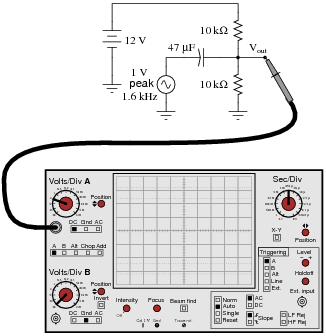
Hint: use the Superposition Theorem!
Reveal answer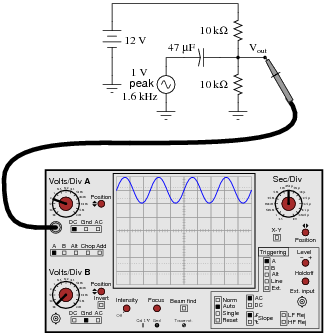
Follow-up question: what would the oscilloscope display look like if the coupling switch for channel A had been set to ÄC” instead of “DC”?
Notes:Note that the capacitor size has been chosen for negligible capacitive reactance (XC) at the specific frequency, such that the 10 kΩ DC bias resistors present negligible loading to the coupled AC signal. This is typical for this type of biasing circuit.
Aside from giving students an excuse to apply the Superposition Theorem, this question previews a circuit topology that is extremely common in transistor amplifiers.
-
Question 17 of 17
Sketch the approximate waveform of this circuit’s output signal (Vout) on the screen of the oscilloscope:
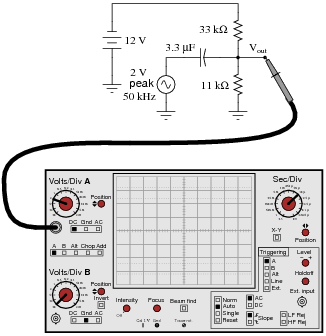
Hint: use the Superposition Theorem!
Reveal answer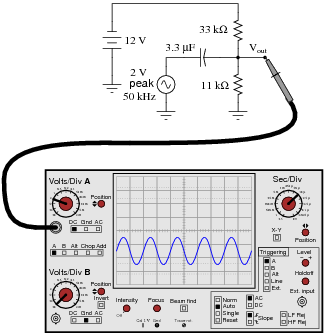
Follow-up question: explain why it is acceptable to use a polarized (polarity-sensitive) capacitor in this circuit when it is clearly connected to a source of AC. Why is it not damaged by the AC voltage when used like this?
Notes:Note that the capacitor size has been chosen for negligible capacitive reactance (XC) at the specific frequency, such that the 10 kΩ DC bias resistors present negligible loading to the coupled AC signal. This is typical for this type of biasing circuit.
Aside from giving students an excuse to apply the Superposition Theorem, this question previews a circuit topology that is extremely common in transistor amplifiers.





As a student, it will be better if these worksheets had not only answers but explanations as well so one can see where they went wrong.
Thank you.