Facebook
 Google
 GitHub
 Linkedin
Analog Devices Rolls Out Rail-to-Rail Amplifier With Low Supply Current
ADI built the new dual amplifier to improve low-power, single-supply designs.
Analog Devices recently released a new dual rail-to-rail CMOS operational amplifier for low-power analog designs. The new product, dubbed the MAX74822 (datasheet linked), features a combination of low input bias current and wide bandwidth to target low-power analog applications like sensor interfaces and mobile communication systems.

The new op amp may find applications in sensor interfaces, medical instrumentation, mobile communications, and portable systems.
Breakdown of the MAX74822
Coming in an 8-lead MSOP package, the MAX74822 integrates two precision amplifier channels that operate from a 2.7-V to 5.5-V supply. It features a rail-to-rail input stage that guarantees linear operation throughout the common-mode range. Under typical conditions, the amplifier exhibits a 1-mV input offset voltage, with a maximum of 5 mV at 25°C, and a drift of 4-µV/°C over temperature. ADI supports these error levels with a 4-pA input bias current that remains below 40 pA across the stated operating point.

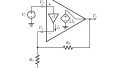
MAX74822 closed-loop output voltage swing versus frequency.
Moving from the input stage to overall linearity, the MAX74822 demonstrates a common-mode rejection ratio of 60–80 dB at 5 V, depending on temperature. Its large-signal voltage gain reaches 101 dB with a 100-kΩ load for precision even in low-power configurations.
ADI also employs a CMOS output stage to maintain rail-to-rail characteristics under load. With a 1-mA load, the output typically swings from 25 mV to 4.9 V, meaning minimal voltage margin exists at either rail. When designers need higher current, the device can source or sink 30 mA at a headroom of 1 V from the supply rails. Its ±60-mA, short-circuit rating enables indefinite fault conditions without degradation.
For dynamic performance, the device offers a 1-MHz, gain-bandwidth product and a slew rate of 0.92 V/µs. ADI also guarantees device stability at unity gain across a range of capacitive loads from 10 pF to 10 nF. Noise characteristics are consistent with the device’s low-power design. A 42-nV/√Hz voltage noise density at 1 kHz and sub-0.1 pA/√Hz current noise helps preserve signal integrity in high-impedance applications.
Rail-to-Rail Input and Output in Low-Voltage Amplifiers
Rail-to-rail input and output stages are necessary for low-voltage analog design.
Such an input architecture needs the differential pair to accept signals ranging from ground to the positive supply. To achieve this range, engineers typically require complementary input transistor pairs or switching architectures to preserve linearity through the transition regions. The design challenge is to maintain consistent gain, offset, and noise behavior while avoiding discontinuities that can introduce distortion or measurement error.
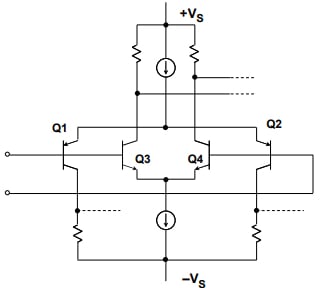
A true rail-to-rail bipolar transistor input stage.
Rail-to-rail output stages face a different constraint. Namely, the output transistor should drive loads as close as possible to both supply rails without saturating. While traditional emitter or source-follower outputs exhibit headroom limitations, modern low-voltage designs use advanced CMOS push-pull stages that minimize dropout. Engineers need output swing near the rails for systems where they utilize the full ADC range or where limited supply headroom restricts signal amplitude. Maintaining this swing under load requires carefully balanced device sizing and bias strategies to avoid excessive distortion or thermal stress.
Low-voltage operation magnifies these challenges because transistor thresholds and saturation regions compress the available linear range. The reduced dynamic performance requires systems with predictable phase margins and consistent behavior under capacitive loading.
Broader Implications for Power-Constrained Analog Designs
The MAX74822 offers a solution that directly addresses long-standing constraints in portable and embedded applications. As designers continue to push for longer operating life in compact systems, devices with this balance of bandwidth, rail-to-rail capability, and low quiescent current will be a boon to future portable analog front-ends.
All images used courtesy of Analog Devices.
Related Content